The Military K9 Obeyed No One — Until a Homeless Navy SEAL Gave One Command
The Military K9 Obeyed No One — Until a Homeless Navy SEAL Gave One Command
PART 1
The first time I saw Havoc, a police officer had a gun pointed at his chest.
The dog was bleeding from the mouth, trapped against a concrete wall, and growling like something that had crawled straight out of hell.
Everyone saw a dangerous animal.
I saw a soldier having a flashback.
Maybe that was because I knew exactly what one looked like.
My name is Declan Cole. Once, people called me Chief. I served in Naval Special Warfare, survived deployments that left better men buried overseas, and came home with metal holding my knee together and memories that refused to stay in the past.
Eventually, I stopped trying to live normally.
Four walls made me feel trapped, crowds made my skin crawl, and sleep usually ended with me waking up ready to fight someone who wasn’t there. So I disappeared beneath an overpass with an old Army jacket, a duffel bag and enough cheap whiskey to keep the worst nights blurry.
That was where I was when the police SUV arrived.
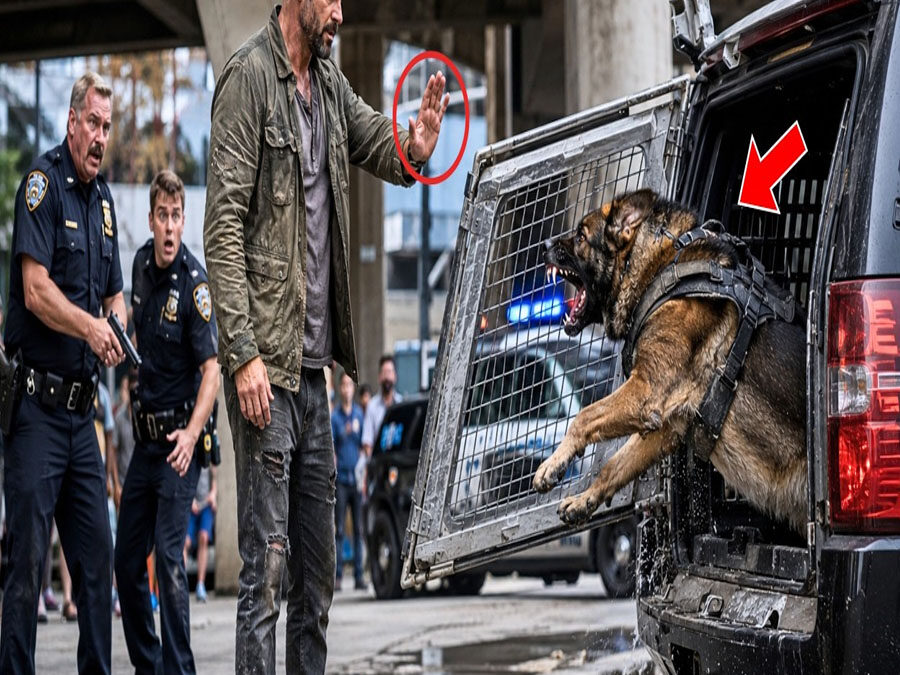
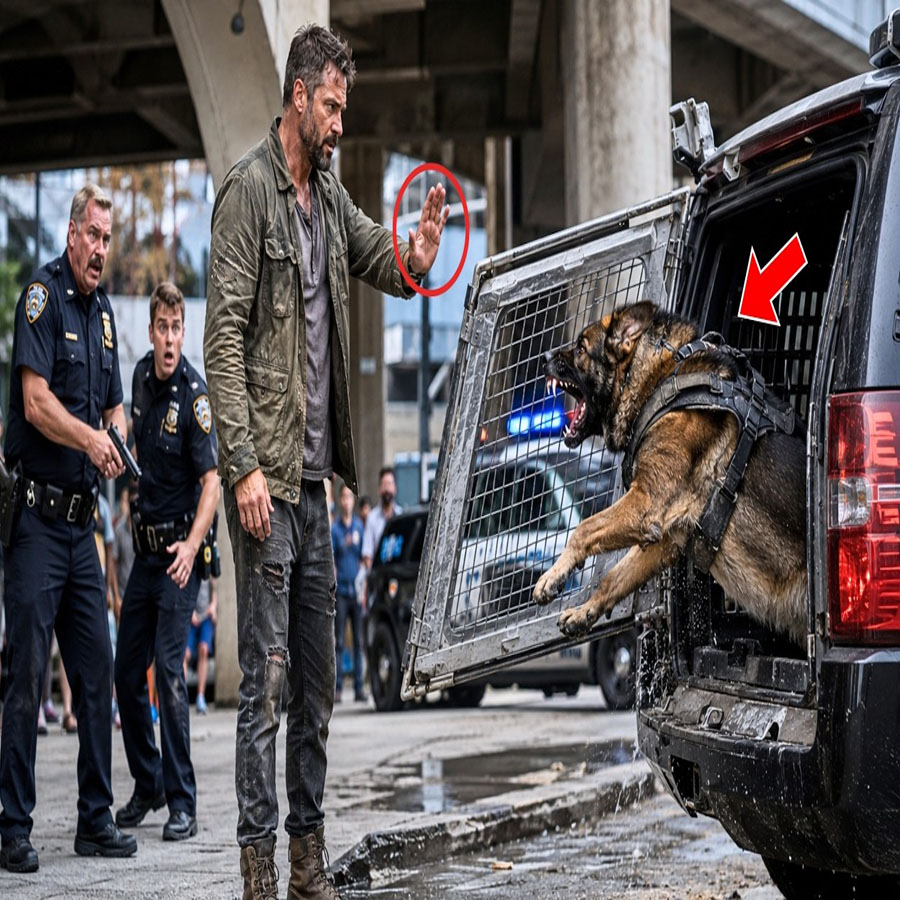
Rain hammered the pavement as the vehicle jumped the curb and stopped near the intersection. The entire SUV rocked violently.
Then I heard the sound coming from the rear compartment.
Not barking.
Screaming.
A German Shepherd was throwing himself against the reinforced cage. Black-and-tan fur flashed behind rain-covered glass. His left ear was damaged, a pale scar crossed his muzzle, and blood already stained his teeth.
Two officers climbed out.
The older one drew a catch pole while his younger partner nervously approached the rear hatch.
I listened to them arguing.
The dog had apparently served overseas. His handler was gone. Rehabilitation had failed. He had attacked trainers, destroyed equipment, and now nobody wanted responsibility for him.
They called him dangerous.
They called him broken.
Those words bothered me more than they should have.
The younger officer opened the cage.
Everything went wrong.
The dog exploded through the door, knocked the officer onto the pavement and scrambled across the wet road.
But he didn’t attack.
He ran.
He backed himself into a narrow corner beside an old tire shop and realized there was nowhere else to go.
The older officer drew his pistol.
The metallic click of the weapon changed the dog instantly.
His panic became training.
His body dropped low. His ears flattened. His teeth appeared.
He had identified the threat.
I knew what would happen next.
If the officer fired and missed the brain or spine, that dog could cover the distance before the man understood what had happened.
More importantly, the animal wasn’t choosing violence.
He was terrified.
So I stood.
My damaged knee screamed as I walked toward them.
“Stay back!” the officer shouted.
I ignored him.
“Police business!”
I kept walking slowly, looking beside the dog rather than directly into his eyes.
“You shoot him,” I said quietly, “and you’re going to make this worse.”
The officer stared at my filthy clothes and unshaven face.
“He’s out of control.”
“No,” I replied. “He’s doing exactly what he was trained to do.”
I stopped several feet away and turned sideways, making myself smaller.
The dog watched me.
I could see the battle happening behind those amber eyes.
Part of him was standing in a rainy American street.
Another part was still somewhere overseas.
I knew that battlefield too.
So I didn’t speak to him like a pet.
I gave him a familiar hand signal, clicked my tongue twice and used the kind of firm German command military dogs learn to obey even when fear overwhelms everything else.
“Down.”
His ears twitched.
The growling weakened.
“Down,” I repeated more softly.
His front legs trembled.
Then something happened that left both officers speechless.
The huge animal slowly lowered himself onto the pavement.
His chest hit the concrete.
His head followed.
And suddenly there wasn’t a monster in front of us anymore.
There was only an exhausted soldier who didn’t understand why his war hadn’t ended.
I knelt.
The dog sniffed my hand.
Then he crawled forward and shoved his scarred head beneath my palm.
Something inside me cracked.
I buried my fingers in his wet fur.
“Easy, brother,” I whispered. “You’re off the clock.”
He pressed himself against my leg.
For the first time in years, another living creature trusted me completely.
Then the older officer said something that turned my blood cold.
“Don’t get attached. Animal control is euthanizing him in the morning.”
I looked down.
Inside the dog’s damaged ear was a faded military identification marking.
Later, at the precinct, I finally learned his name.
Havoc.
I refused to leave him.
Eventually they locked both of us inside an empty holding cell because Havoc wouldn’t allow animal control near him without becoming aggressive again.
He lay against my boot while I rested my hand on his back.
Then footsteps approached.
A police captain stopped outside the bars carrying a thick file.
He studied me before opening it.
“Havoc. Military working dog. Two combat deployments. Explosive detection and tactical patrol.”
My fingers stopped moving.
The captain continued.
Havoc’s handler had been killed overseas.
The dog had guarded his body for hours and attacked anyone who tried to remove him. Afterward came multiple rehabilitation programs, multiple incidents, and finally one official classification:
Unadoptable.
Too dangerous.
Broken beyond repair.
Those three words hit me harder than they hit Havoc.
Because years earlier, someone had written almost the same thing about me.
The captain closed the folder.
“The veterinarian is here,” he said. “They brought the injection.”
Havoc’s heartbeat hammered beneath my hand.
I looked through the bars at the captain.
Then I said the four words that would change both our lives.
“He’s coming with me.”
PART 2
The captain actually laughed.
Not because anything was funny.
Because he thought I was insane.
“With you?”
His eyes traveled over my torn jacket, muddy boots and unwashed clothes.
Then he told me something I hadn’t expected.
They had run my fingerprints.
He knew exactly who I was.
“Chief Petty Officer Declan Cole. Naval Special Warfare. Two Silver Stars. Purple Heart. Honorable discharge.”
Hearing my old identity spoken aloud felt like hearing the name of a dead man.
Then his voice hardened.
“You sleep under a bridge, Cole. You don’t have a permanent address. You’re barely taking care of yourself. And you think we’re handing you a traumatized military working dog?”
I looked at Havoc.
He was watching me.
Waiting.
That was the terrifying part.
For years, nobody had needed me.
I had deliberately made sure of it.
If nobody depended on me, I couldn’t fail anyone.
Havoc had destroyed that arrangement in one rainy night.
“I’ll get a house.”
“With what money?”
I reached into my jacket and removed my battered wallet.
The captain tensed until I tossed it through the bars.
“Call the bank.”
He frowned.
“My disability back pay has been accumulating for years. I haven’t touched it.”
According to my account, there was more than sixty thousand dollars waiting for a man who had spent years pretending he owned nothing.
“Verify it,” I said. “Then bring me whatever paperwork I need.”
The captain stared at me for a long moment.
Then he picked up the wallet and walked away.
Havoc lowered his head onto my boot.
That was when fear finally reached me.
Not fear of the police.
Not fear of the dog.
Responsibility.
If they agreed, tomorrow I couldn’t disappear.
I would need shelter.
Food.
Veterinary care.
Training.
Sobriety.
Routine.
Havoc didn’t need a man hiding beneath a bridge.
He needed the man I used to be.
And I wasn’t sure that man still existed.
Eventually, the captain returned.
There were forms.
Lots of them.
I signed liability waivers until my hand started trembling.
Then they brought Havoc’s tactical harness.
I knelt in front of him and secured it around his chest.
Click.
The metal buckle locking into place sounded strangely final.
Havoc looked at me.
“Guess it’s you and me now.”
We walked toward the precinct entrance.
The automatic doors opened.
Havoc froze.
Traffic hissed across wet pavement. Somewhere nearby, machinery groaned. A siren echoed between buildings.
His breathing accelerated.
I felt his shoulder press hard against my leg.
For one second, I almost turned around.
Instead, I wrapped the leash securely around my palm.
“Heel.”
Havoc looked up.
Then he stepped forward.
So did I.
We walked into the city together.
The first weeks were ugly.
I rented the cheapest small house I could find with enough outdoor space for Havoc. I bought a mattress, two chairs, dog food, medical supplies and almost nothing else.
Then I poured every bottle of whiskey I owned down the sink.
Havoc watched from the doorway.
“Don’t look impressed,” I told him.
He wasn’t.
He was too busy checking the windows.
We developed rules.
No sudden touching while he slept.
No crowded streets unless necessary.
No fireworks.
No strangers entering without controlled introductions.
In return, Havoc developed rules for me.
Get out of bed.
Eat.
Walk.
Sleep.
When nightmares woke me, he appeared beside the mattress before I completely understood where I was.
Sometimes I woke with my fist raised.
Havoc never attacked.
He simply pressed his body against me until my breathing slowed.
And when thunder sent him scrambling beneath the kitchen table, I sat on the floor nearby until his trembling stopped.
We never cured each other.
That isn’t how trauma works.
We learned each other’s triggers.
Then we learned how to survive them.
Weeks became months.
My beard disappeared.
I started physical therapy again.
My knee still hurt, but I stopped using pain as an excuse to remain motionless.
Eventually I contacted men from my old unit.
The first call lasted less than a minute.
The second lasted ten.
One of them drove across two states just to see me.
When he stepped from his truck and saw Havoc beside me, he smiled.
“Of course you adopted the most screwed-up dog in America.”
I looked at him.
“He adopted me.”
For once, I wasn’t joking.
People had tried to repair Havoc by forcing him to become the dog he had been before his handler died.
People had tried something similar with me.
Return to normal.
Move on.
Forget.
But some experiences don’t leave.
You build a life around the scars instead.
Havoc never became an ordinary dog.
He remained vigilant. Certain noises still frightened him. He never liked strangers approaching from behind.
And I never became the man I had been before deployment.
But that stopped mattering.
One evening, I sat on the porch watching Havoc lying in the grass.
His scarred muzzle had gone gray around the edges.
A motorcycle backfired somewhere down the street.
His head shot up.
Months earlier, that sound would have sent him into panic.
Now he looked toward me.
I tapped my chest twice.
His body relaxed.
He lowered his head again.
That tiny movement nearly broke me.
Because I finally understood something.
The police had believed I saved Havoc from an injection.
They were wrong.
Before that dog appeared, I wasn’t really living.
I was surviving one bottle, one nightmare and one cold night at a time.
Havoc gave me something I hadn’t realized I’d lost.
A reason to wake up tomorrow.
I walked down from the porch and sat beside him.
He immediately leaned his heavy body against mine.
I scratched behind his damaged ear.
“Still broken, brother?”
His tail struck the grass once.
I smiled.
“Yeah. Me too.”
Then we sat there quietly—two former soldiers nobody knew what to do with, neither repaired, neither perfect, but still here.
And for us, that was enough.
Sometimes the ones everyone calls broken aren’t waiting to be fixed.
They’re just waiting for someone who understands how to stay.