The Army Gave Me Five Minutes With a German Shepherd Two Handlers Had Already Given Up On. I Whispered Two Words, and He Fell Into Step Beside Me. Then His Sergeant Asked Why I Knew the Name on His Old Harness. aviet7
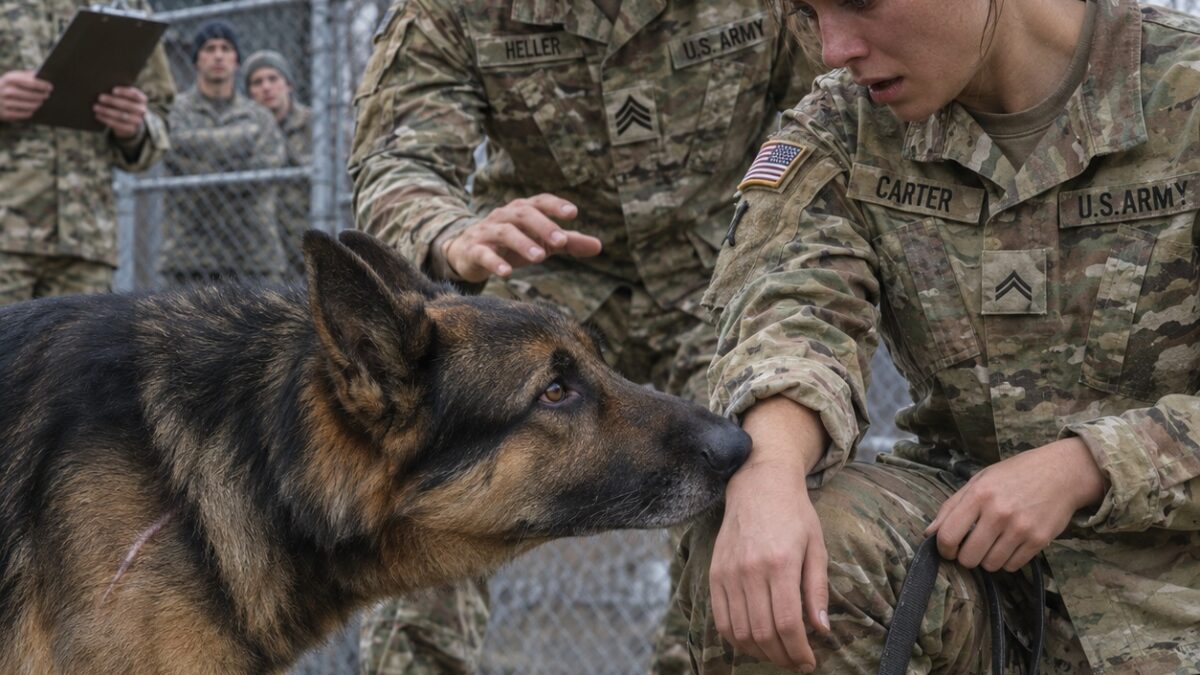
The Army gave me five minutes with the dog that had put two handlers on medical leave.
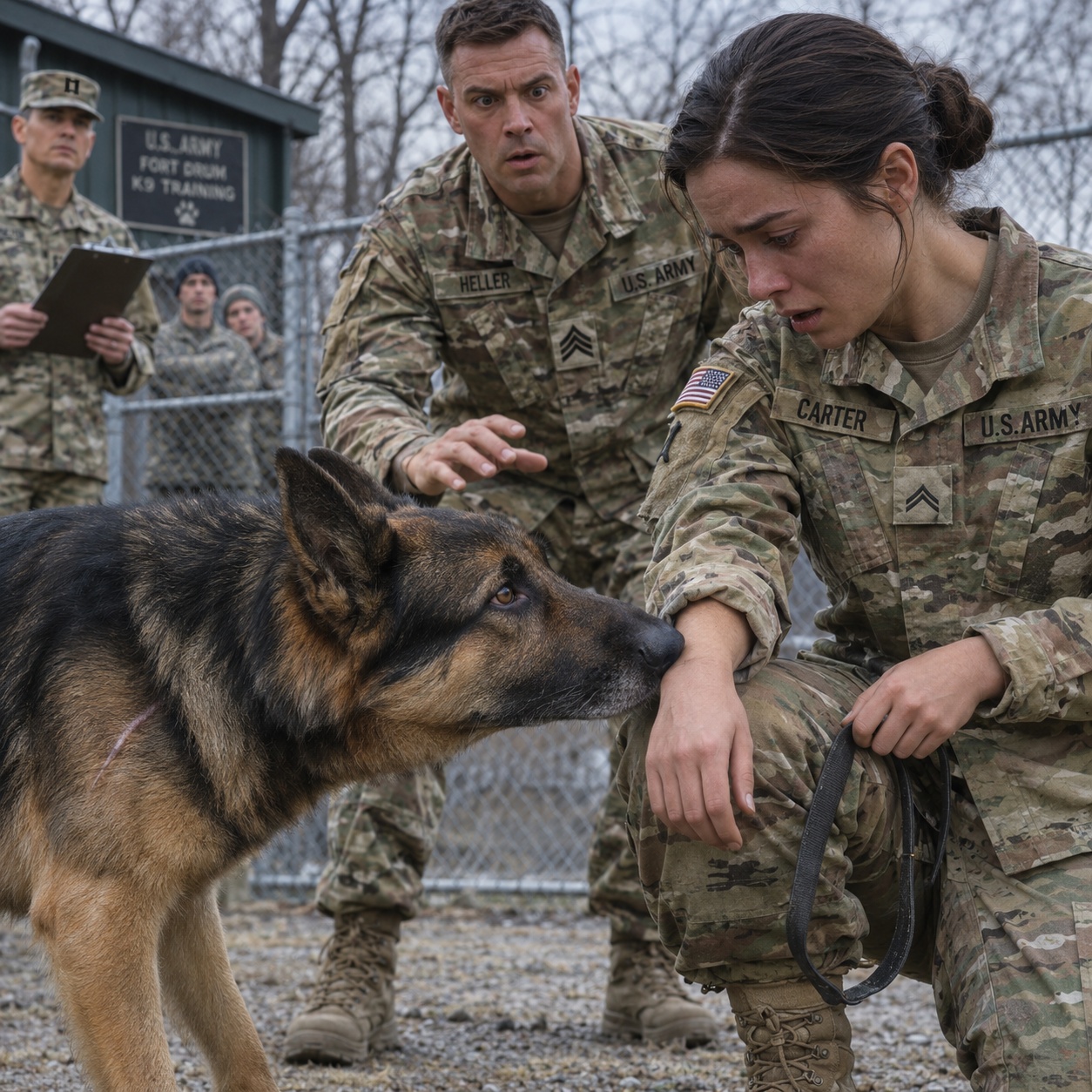
I whispered two words. He stood up, walked to my left knee, and waited.
Then the sergeant asked how I knew the name on his old harness.
Nine months earlier, someone in an Army hospital had told me this dog was dead.
My name is Leah Carter. By the time I got to Fort Drum, I was a corporal in logistics. I issued truck keys, checked inventory, and knew which copier tray you had to kick to make it close. If anybody asked about my last posting, I said I’d spent a lot of time moving equipment. Usually that was enough to make them change the subject.
Eleven days into the assignment, I heard a kennel gate slam from across the road. A man shouted a command. What came back was a sound I’d heard once in a place where it took three days for anyone to reach us.
I nearly dropped the keys I was carrying. I closed my fist around them until one of the teeth dug into my palm, then kept walking.
Lieutenant Dana Price caught up with me outside the motor pool. She ran the K-9 detachment. I knew her mostly from the stack of vehicle requests she turned in on Mondays, always clipped together, always with a coffee ring on the first page.
“You stopped when you heard him,” she said.
“So did a couple of other people.”
“They looked toward the noise. You looked toward the trees.”
I had no answer for that.
She told me the German Shepherd was on his last evaluation. Six years old, eight weeks in rehabilitation, three handlers who couldn’t get through a full session with him. Two had been hurt. If Friday went the same way, the captain would sign a recommendation that could end with the dog being put down.
She told me they called him Atlas.
That night I lay awake until the heater in the barracks stopped rattling. Then I put on my boots and went for a run. The road curved past the kennels. From the far side of the fence I could see a shepherd standing at the back of his run, watching the strip of woods beyond the floodlights.
He shifted his weight. A pale mark showed through the fur on his shoulder. I remembered seeing that same mark wet, with my hand pressed over it while I tried to stay awake.
I’d spent months remembering the last thing I said to him and wondering whether he’d heard me.
I almost said his name then. Instead, I stood beside the fence and watched the trees with him. After a while he turned his head. I couldn’t tell what he recognized in the dark. I knew what it cost me to go back to the barracks and leave him there.
On Friday, Sergeant Wade Heller took him into the yard on a short lead. Heller had been handling dogs since I was in high school. He had a pink scar across one knuckle and a habit of looking down at it whenever somebody asked him about the first handler Rook had hurt.
Rook sat at the first marker. When Heller asked him to move, he watched the gate.
Heller tried again. Someone along the fence shifted their coffee to the other hand. At last Captain Joel Mercer set his clipboard on a bench.
“Let’s talk about the recommendation,” he said.
“Can I have a minute with him?”
People turned toward me. I hadn’t planned to say it loud enough for the whole fence line to hear.
Heller looked at the clipboard I’d brought from logistics. “You ever held the lead on a dog like this?”
“Yes.”
Mercer studied me for a long moment. Then he looked at Price. She gave him a small nod.
“Five minutes,” he said. “I want the yard clear.”
Heller handed me the lead and stayed close enough to take it back. I could see the tendons in his hand jump when Rook turned toward me.
“Here, Rook,” I said.
I’d said those words hundreds of times. I used to say them in the morning before I’d had water, before I could get much sound out. I said them the same way now.
He rose. For a breath I thought he was going to pass me and head straight for the gate. Instead he came around to my left side and touched his nose to my wrist. I took a step. He took one with me.
We walked to the end of the yard and back. When I stopped, he settled beside my boot. I hadn’t seen that much of his face at once since the morning we left for the mountains.
Heller was staring at the lead. “The old harness had ‘Rook’ stitched inside it,” he said. “His kennel paperwork says Atlas. Who told you what to call him?”
I looked at the captain’s clipboard. I knew that once I answered, somebody would have to write it down.
“I gave him that name,” I said. “He wore that harness the night my entire team went down.”
Heller’s hand opened. He’d been reaching for the lead without realizing it.
Captain Mercer picked up his clipboard and told the observers to clear the fence. A few people started talking as they walked away. I heard someone ask what team I meant. Mercer waited until the gate shut behind the last of them.
“You were his handler?”
“I led the team,” I said. “Rook worked with me.”
Price looked down at the dog, then back at me. “Why did you tell me you worked in logistics?”
“Because that’s what the Army told me to say.”
Mercer asked whether I could put any of that in writing. I said I could if he could tell me who would read it. He thought about that for a moment and said he could start by making sure Rook got a fresh evaluation. He’d need something he could defend on paper before the recommendation was due.
Heller squatted to retrieve his gloves. “I’ve got a guy who still can’t button his shirt with his right hand,” he said. “A walk across the yard is a good start. I need to see what happens when the dog has a bad day.”
He was right, and I was scared enough for Rook that I hated him for being right.
Mercer granted a temporary hold and assigned me to the detachment under Price. A young specialist named Maya Brooks showed me where they kept the feeding logs. She’d been writing down when Rook ate, how much he left, and where he was looking when people came to the kennel. I asked why she kept a second set of notes.
“Because the form has a box for ‘refused food.’ There isn’t one for ‘ate after everyone went home.’”
She’d drawn a little diagram of his run. Nearly every mark was at the back, facing the woods.
On our third morning together, a metal door slammed and Rook was back against the fence before I knew he’d moved. I said his name. His eyes went right past me. A minute later I realized I’d been gripping the lead so hard my hand hurt.
Brooks went to ask the crew working nearby to give us a few minutes. I stayed where I was. When Rook finally came away from the fence, he stopped halfway across the yard and sat. I sat down on the ground where he could see me. The dirt was cold enough to feel through my uniform. We stayed out there until Brooks came back with two coffees and set mine where I could reach it.
A week later, Heller came to watch. When Rook stopped in the middle of an exercise and looked toward the woods, Heller started to speak. Then he put his hands in his pockets. After a while Rook turned back on his own.
“How often did he do that before?” I asked.
“Every day,” Heller said. “I kept trying to make him finish.”
He came back the next morning. He stood at the fence for the entire session. When it was over, he asked Brooks if he could see her notes.
I thought we were making progress. Then a transfer order arrived from outside the installation. Rook was to be sent to another facility before the new evaluation could be completed. The order referred to him by his old name, the one that appeared nowhere in his current kennel paperwork.
I brought it straight to Mercer.
“Can you hold him here?”
“Long enough to ask why somebody’s in such a hurry.” He reached for his phone. “Can you tell me what they’d be worried he could prove?”
I looked through the window toward the kennels. Brooks was carrying a bucket down the row. Rook had learned the sound of her footsteps. I could see him get up before she reached his gate.
“He can prove I was there,” I said.
The order stayed on hold. Price found the original assignment sheet through the veterinary records. My name and Rook’s were on the same line. Mercer sent it to an inspector who was already reviewing a discrepancy in the casualty records from our operation. Within days, Colonel Aaron Doyle, my former commander, was sitting across from me at Fort Drum with the inspector and a closed folder between them.
Doyle looked older than I remembered. He asked if I wanted water. I said yes, then watched him pour it into a paper cup that folded a little under his thumb.
The inspector opened the folder. Inside was the written warning I’d submitted before the mission. I’d said the risk to our team was higher than the authorization acknowledged and asked for more support. I remembered writing it twice because I’d been worried the first version sounded angry.
Behind it was the approval with Brigadier General Victor Hale’s signature. The inspector put another document beside it. Same signature. That one removed me from the list of people who could give firsthand testimony to the review.
The Army had listed me as attached support. According to the official account, none of the people in a position to challenge the mission plan had survived.
“You knew I’d written that warning,” I said to Doyle.
“Yes.”
“Did you ever ask me what happened?”
“I tried to get your statement added after I found out they’d transferred you. I should have pushed when you wrote the warning in the first place.”
He looked at me like he was waiting for me to tell him that had been somebody else’s decision.
I let him wait.
The inspector asked if she could start the recorder.
I’d imagined this moment in more rooms than I can count. In every version I knew exactly where to begin. When the little red light came on, all I could think about was how many people had called my hospital room to tell me which forms I needed to sign. Nobody had asked me to say the names of the people I’d gone into the mountains with.
I started with their names.
Five people died. I was hurt badly enough that I kept losing track of where I was. I remember waking once with Rook pressed against my ribs and thinking I was back in a bunk with him taking up more room than he was supposed to. Then I moved my hand and felt rock.
The rescue crew found us seventy-one hours after we went in. Rook was still beside me. I’d told him he could go, although I doubt I said it loud enough to hear. What I remembered most clearly was the weight of his head coming back down across my arm.
“When I woke up in the hospital,” I told the inspector, “they said he hadn’t survived. I asked where he was buried. They sent me a transfer date.”
The inspector asked who had given me that answer. I told her everything I could remember, including which parts I was unsure of. Then I asked her to read my team’s names back to me. On the third one, she got the pronunciation wrong. I corrected her. She said it again.
The investigation took months. The transfer order was canceled first. Rook passed a new assessment that let him stay with the detachment while we worked together. Heller signed it. He also attached a page about what happened when Rook got frightened and how long he needed to settle. I read it twice. I’d never seen anybody give the dog that much room on a form.
My own correction took longer. When Mercer handed me the amended record, my rank was staff sergeant again, and the work I’d done with Rook was back under my name. The inspector’s office had opened a wider inquiry. Another survivor’s file carried a change that looked like mine.
Her name was Tessa Grant. I called her after she agreed to speak with me. She let me finish before she asked, “Was it worth it?”
Rook was lying under my kitchen table. He’d started sleeping there because I had a habit of getting up in the middle of the night and sitting at it. I’d found that if I left both feet on the floor, eventually he’d put his chin on one of them.
“Some days I couldn’t tell you,” I said. “But they read my team’s names into the record. I heard every one.”
Tessa was quiet for so long I thought the call had dropped. Then she asked if I could stay on the line while she wrote down the inspector’s number. I listened while she went to find a pen.
By winter, Doyle had asked me to visit four dogs in rehabilitation who’d lost handlers. I asked if Rook could come. Doyle wanted to know if I thought seeing him would help.
“I’d like them to meet him when he’s having an ordinary day,” I said. “And I’d like to see what an ordinary day looks like for them.”
Brooks was on feeding duty the morning we left. She carried a bowl to the back of an empty run, changed her mind, and brought it back toward the gate.
“You think I’ll know when to move it closer?” she asked me.
“Watch what happens when you leave it there,” I said.
Heller was waiting by the transport van. He reached down and held his hand where Rook could investigate it. Rook sniffed his fingers and leaned his shoulder against Heller’s shin for just a second. Heller looked up at me. I’d never seen him smile where anyone could catch him doing it.
Rook climbed in and took the window seat. As we passed the kennel yard, he lifted his head. I followed his eyes to the strip of woods where he used to stand watch. I could still picture him there in the dark, and I could still feel how badly I’d wanted to call his name.
He watched until the trees were gone. Then he turned around twice, lay down beside me, and went to sleep before we reached the highway.