Koko the Gorilla Kept Asking Me for a Cat. I Gave Her a Stuffed One First, and She Set It Aside. Months Later, I Sat Across From Her With Empty Hands and Tried to Tell Her Why
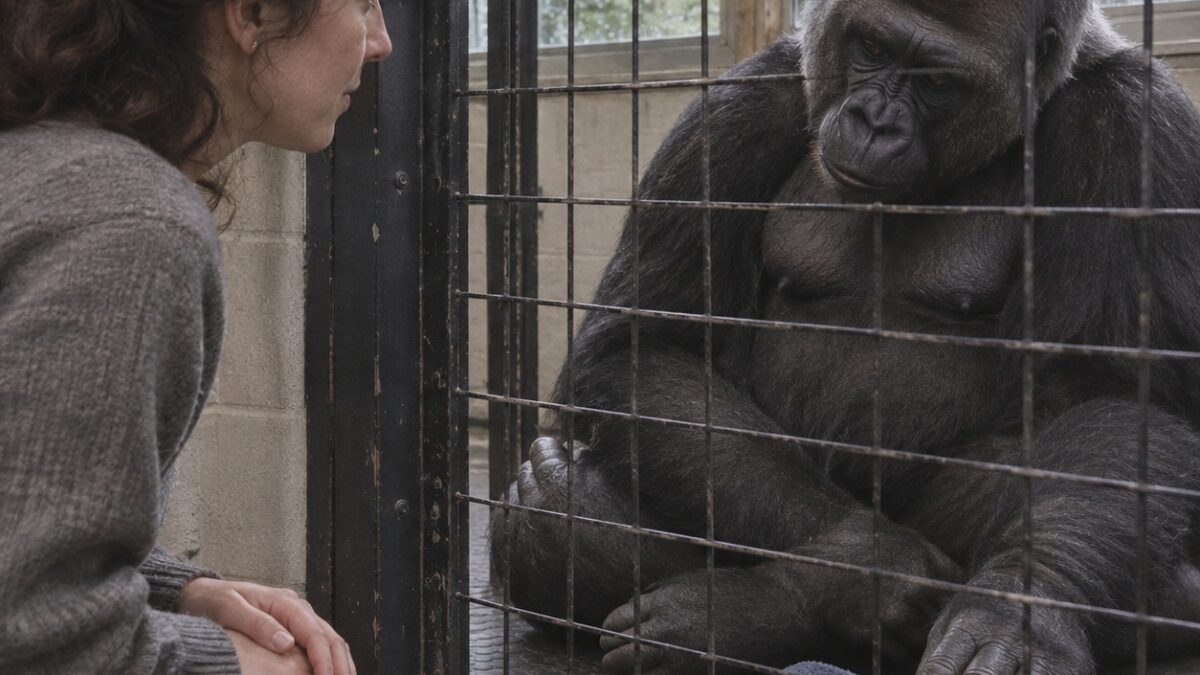
An orange thread from the stuffed cat hung from Koko’s thumb.
She picked it off, set the toy on the floor, and looked straight at me.
Then she made the sign I’d been seeing for weeks.
Cat.
I’m Francine Patterson, though everyone at the research project called me Penny. By then I’d spent more than a decade in Northern California working with Koko, a western lowland gorilla who’d been born at the San Francisco Zoo. My job was to teach her signs and keep track of what she did with them. I had pages of notes on that particular sign. I’d made one very confident assumption about what would happen when I brought her that toy.
I thought she’d keep it.
When we started working together, Koko was about a year old. She’d been seriously ill as an infant and had spent some of those early months being cared for by people. She was used to watching our hands. I began with things I could show her, offer her, or do again if she asked. I learned to take my own hands out of the conversation long enough to see what hers would do.
That was harder than it sounds. If I held up a cup and asked about drinking, I’d already supplied half the answer. The observations I liked best were the ones that caught me doing something else. The first time I remember Koko asking for a cat, I was holding a picture book. She put a finger on the drawing and signed. I turned the page. She turned it back.
A few days later she signed cat at a meal, with no book in sight. Then she did it during play. I brought the stuffed cat in partly because I wanted to see what she’d do with it and partly because I liked giving her things she enjoyed. She could get excited over a clean stack of towels. I figured a soft toy with ears had a decent chance.
She left it where she’d put it. I took it home and put it on top of my washing machine. A week later I was still looking at it every time I did a load of laundry.
When we arranged for Koko to meet a litter of kittens, I was the one who kept going over what we’d do if we had to end the visit. I’d seen her pull apart things I needed tools to open. A kitten could scramble down her arm faster than any of us could get to it. I wanted to give her a chance to choose. I was also the person who’d have to call it off if I saw a reason to.
She looked over the litter and settled on a little gray tabby with hardly any tail. When she lifted him, I leaned forward so quickly that my knee caught the edge of a chair. The kitten tucked his paws against himself. Koko brought her other hand underneath him and waited while he got comfortable. I eased my knee back.
She named him All Ball. We called him Ball when we were looking for him, which was most of the time he was on the floor.
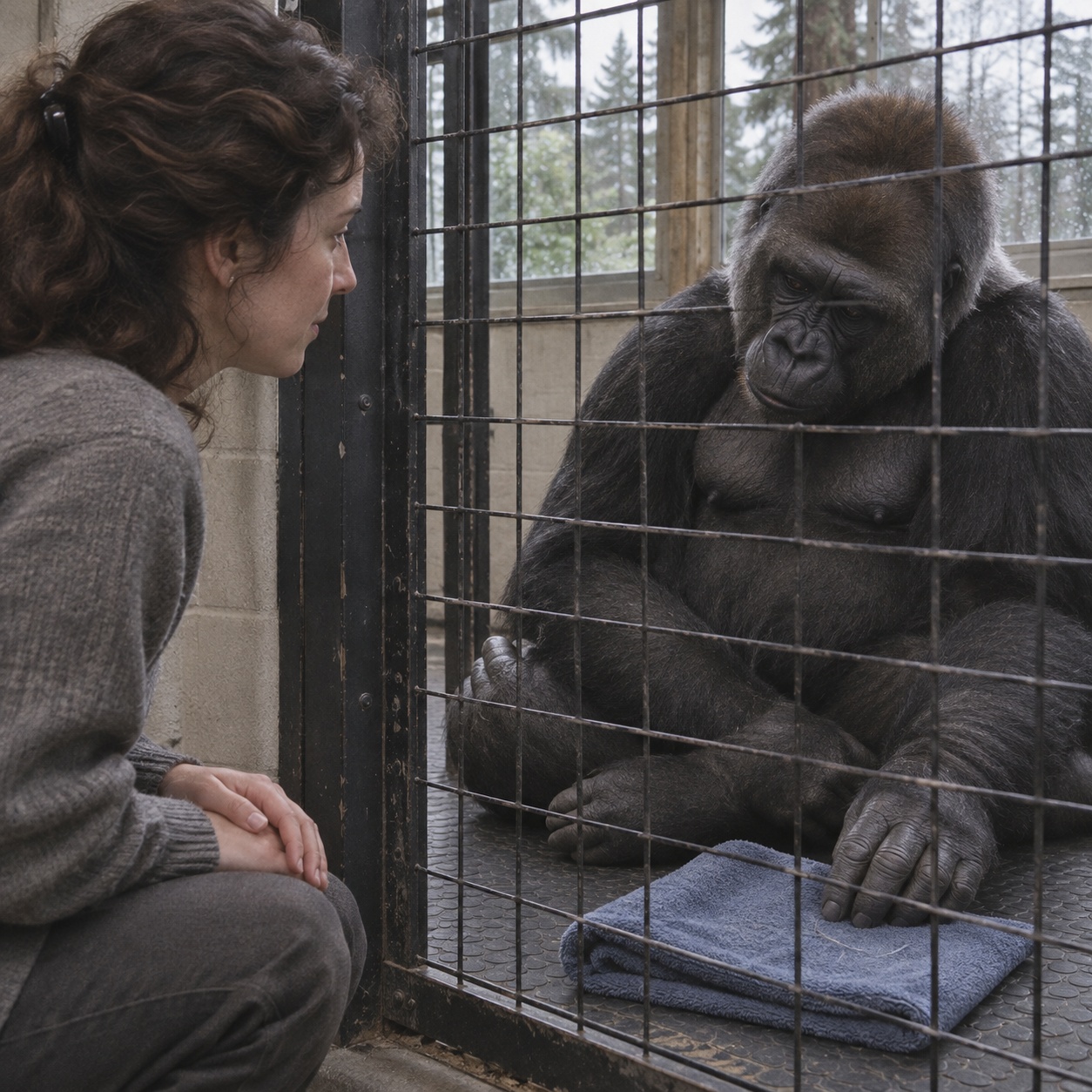
During their visits I spread a blue towel where Koko liked to sit. She sometimes brought Ball onto it, and sometimes let him climb straight into her lap. He’d work his way up her chest with his front claws and then fall asleep halfway to wherever he’d been going. Once, when I came to take him at the end of a visit, she drew her elbow in just enough to keep him from rolling. I waited. When he woke up, she let me lift him off.
I came to look forward to folding that towel at the end of an afternoon. There’d always be a hair or two I couldn’t brush away. I’d pick at them in the hallway while Koko watched to see whether I was coming back with him. Most days, if I had time, I gave them a few extra minutes.
In December, someone came looking for me while I was folding towels. Ball had slipped out. I set the stack down and went to check the places where a kitten might get himself stuck. I got on my knees and looked behind things with a flashlight. By then it was raining hard enough that every time I opened an outside door, I had to stop and listen before I moved.
I was back inside, trying to remember which parts of the grounds I’d checked twice and which I might have missed, when a colleague came in. He stood on the mat with rain dripping off his cuffs. I asked if he’d found Ball. He nodded, and I reached for the blue towel on the top of the stack.
“A car hit him, Penny. He’s dead.”
I put the towel back down.
“Are you sure it was him?”
My colleague nodded again. I remember looking at his hands as if there might be a carrier just out of sight. He told me where they’d found Ball. I asked him to take me there, then asked him to give me a minute. He stayed on the mat while I straightened the corner of the folded towel. It had been straight before I touched it.
Koko had seen me leave with Ball dozens of times. I carried him away at the end of a visit, and the next time she saw me with the towel, he usually came back. I could keep the towel out of sight for a while. I could change the order of the day and give her something else to do. Part of me wanted to try that for an afternoon, just to have an afternoon in which I could walk down the hall without having to tell her.
I took the towel with me.
She was sitting near the partition when I came in. I put the towel on her side where I usually spread it, still folded. She looked at it, then past my shoulder toward the hallway. I’d seen that look when somebody was following me with her lunch or a book. I waited until she looked at me again.
I said Ball’s name out loud and used the signs I had to tell her he’d been hit by a car and had died. I went slowly. At one point I started a sign over because my fingers had got ahead of me. I had to face the fact that I could say the words as clearly as I knew how and still have very little idea what she’d made of them.
For a little while she watched my hands. Then she moved hers. I recognized signs I’d recorded before as sad and cry. There was another movement I’d sometimes written down as trouble. I almost asked her a question. My hands had come up off my knees before I realized I was getting ready to ask it.
She turned away, and I put them back in my lap.
I stayed there a while. When I finally stepped into the hall, I heard a long, low call from inside. There was a pause and then another. I put my hand on the doorframe. From where I stood, I couldn’t see her face. I could see the empty towel.
My colleague was at the far end of the hall. He started toward me, then stopped when he heard her. We stood there with several yards between us. I remember one of the overhead lights had been flickering for weeks. I’d ordinarily have gone down the hall briskly just to get out from under it. That afternoon I stood beneath it until the room behind me went quiet.
Later I tried to write down what I’d seen. I put the sequence on paper in the simplest terms I could. There was a place on the page for the signs I’d used and another for what Koko had done. I wrote that she had looked toward the hall when I arrived. I wrote down the movements I recognized. I left space where I couldn’t remember the order.
At home that night, I set a load of laundry on the washing machine and knocked the stuffed cat onto the floor. I’d forgotten it was still there. I picked it up by the middle and felt how evenly the stuffing was packed, how it gave the same amount everywhere I pressed. Ball had been warmest under his front legs. When he was sleepy enough, he used to let his head tip back against the heel of my hand. I stood there holding the toy until the washer finished filling.
In the weeks after the accident, we kept the ordinary parts of Koko’s day going. There were meals, fresh bedding, and visits from people she knew. Sometimes she took a book from me. Sometimes she left me holding it. Certain pictures of cats made her turn away. On days when she wanted to look at one, I let her hold the page open as long as she wanted.
I’d spent years trying to get as clear an answer as I could from Koko. There were good reasons for that. Other researchers wanted to know what counted as a sign, how often she used it on her own, and how much a person sitting across from her might be giving away. I’d asked some of the same questions about my own work. I knew how easy it was to see a movement you hoped to see, especially when you’d been watching for it all day.
Months after Ball died, I asked Koko about him again. I remember her using a sign I understood as sleep, and I remember goodbye. On other occasions, when we’d talked about where animals went when they died, I’d understood her to describe a comfortable hole. For a while I caught myself trying to fit those pieces together in my head. I could imagine Ball curling up somewhere out of the rain. I had to leave open what Koko pictured, if she pictured anything.
I could be sure of the afternoons I’d watched them spend together. I knew how gently she moved her leg when he was asleep on it. I knew that after he died I could walk into the room at the usual hour, with everything else about the visit arranged the usual way, and there was still somewhere past me she would look.
One day I went in without a book or anything in my pockets. Koko was occupied with a piece of bedding she’d pulled against the wall. I sat down at the partition. After a while she came over and sat near me, both of us facing the same way. I’d planned to stay five minutes. Someone slid a note under my office door while I was gone, and by the time I came back it was almost lunchtime.
When there was a chance for another supervised visit with a kitten, I took longer to say yes than I’d expected. The part I could talk through with the staff was straightforward. I wanted a person assigned to the kitten from the minute it came out of its carrier. We’d go over every door the kitten would pass through and decide who was responsible for each one. We walked the route together. At the outside door I pulled the handle after it latched. Then I asked the person with me to do it, too.
The part I had trouble putting into words was what I’d do if Koko saw a kitten and looked toward the hall for Ball. I could picture it as easily as I could picture her taking one into her arms. On the morning of the visit, I stood in the supply room with my hand on the old blue towel. I left it folded on the shelf and took a clean one from the stack.
Koko was fourteen when she met the reddish kitten she would call Lips. I remember the little adjustments she made while she held him in front of a mirror. The kitten would shift, and she’d adjust her grip, then look up again to see the two of them. I could see her face in the glass. From where she was sitting, she could probably see mine, too. I let her watch as long as she wanted.
There was a gray cat named Smokey in her life, too. Years went by. The people working with Koko changed, and so did the equipment we used. Video cameras got smaller and easier to bring into the room. I still caught myself doing the same thing I’d done with a paper notebook, glancing down to make sure I was getting it and missing a little of what I’d come to see.
By her forty-fourth birthday, Koko had started asking for a kitten again. I showed her a photo of one she might meet, and her hand went up in the familiar sign. I thought of that picture book and how certain I’d been that I could turn the page. This time I held the photo still. She had a good long look at it.
When the kittens came, we let them come out at their own pace. One gray kitten headed toward Koko with the brisk, mildly annoyed expression kittens have when the floor takes too long to cross. Koko extended her hand and rested it where the kitten could reach it. The kitten stepped onto her palm.
There were two kittens she spent time with that year, a gray one and a dark one. During one visit a kitten ended up on top of Koko’s head. The rest of us were trying to keep our voices down, which got considerably harder when it put a paw forward and had to think about where to put the next one. Koko sat still. She’d done the same thing for Ball when he was asleep against her chest. If she moved at all, it was after the kitten had settled.
I’d been ready, that day, to watch for a sign I could recognize. A camera was running, and I knew we could look at the footage later if we wanted. I put my hands down and watched the kitten turn in place.
After Koko died, I went through some of my old notes. I could tell which pages I’d written in a hurry by how far the date leaned into the margin. On one page from the time Ball was alive, I’d written down when a visit began and what Koko did when I brought him in. I’d made room for the signs she used. At the bottom, in smaller writing, I’d squeezed in that she’d stayed in one position for so long that I’d moved my chair closer to see what was happening.
What I remembered was how the chair leg scraped. Ball opened one eye. Koko looked up, and I knew to stop right where I was.
I waited with my hand on the back of the chair. Ball closed his eye again. Under his feet, the blue towel had bunched into a little ridge. Koko hooked one finger under the loose corner, drew it flat, and left her hand there beside him.