I Was Ordered to Stay Behind While Five Navy SEALs Were Trapped. I Went Anyway. When I Returned, My Commander Had Two Envelopes on His Desk, and the Man I’d Pulled Out Was Still Fighting to Make It Home. aviet7
I heard Lieutenant Commander Owen Beck ask for a medic.
Then I heard him say the medic was down.
The officer at the radio told me to stay where I was. Behind his voice, over the open channel, somebody kept saying, “Eli, stay with me.”
Eli Navarro was twenty-six. That morning he’d asked me to sign a clearance form before breakfast and stood outside the medical tent eating a granola bar while I finished it. There was still a corner of the wrapper on my desk because he’d missed the trash can.
I could hear Owen trying to get him to answer.
“Five of us,” Owen said over the radio. “Three injured. One critical.”
The evacuation helicopter was twelve minutes out. The extra ground crew was farther away. I asked the operations officer whether the helicopter could get to Owen where he was.
“Not where they are now,” he said, and leaned back toward his microphone.
My name is Dr. Kate Mercer. I was a Navy physician, thirty-four years old, with twelve years in uniform and three deployments behind me. I was the senior medical officer assigned to Owen’s platoon. Back in Virginia Beach, I’d known some of the men long enough to get Christmas cards from families I’d never met. Once, Owen’s wife had written on the back of one, Tell him the boys can tie their shoes now. He won’t believe me.
I took my medical bag off the hook.
“Captain Mercer,” the operations officer said. “You’re staying here.”
I asked him again how long until somebody could reach them on the ground. He gave me the estimate he’d already given Owen.
“That leaves us without a physician here if anything happens to you,” he added. “Stay put. That’s an order.”
I could understand his arithmetic. I was usually the person asking people to think about the next patient while the one in front of us was taking up the whole room. I stood still long enough to hear Owen try the radio again. What came through sounded like a man talking into a phone after the person on the other end had already hung up.
I picked up the bag and walked out.
The radio in the Humvee came alive shortly after I started driving. The operations officer told me to turn around. I heard him clearly. Later, when someone asked whether I might have missed the transmission in the noise of the engine, I said no.
I’d spent years being the officer whose name never came up when there was trouble on a deployment. I signed what I was supposed to sign. I showed up early enough that other people used my arrival to tell time. As I drove, I realized I was still hoping the radio would come on with somebody telling me to go ahead. I’d have liked to get there with permission.
The road took me as far as the edge of the buildings. I went the rest of the way on foot with my bag. By the time I found Owen and reached the low wall the team was trying to use for shelter, my mouth was so dry I had to say his name twice to get it out properly.
He turned. “They sent you?”
“I came.”
For a second I thought he’d tell me to go back. Instead he shifted over to give me room beside Eli.
One man had a leg injury. Another was holding his chest and insisting he could walk. Eli hadn’t opened his eyes since Owen called. He’d been breathing on his own, but every breath took more work than the one before it.
“We have to move,” Owen said.
“Give me a minute with him.”
Owen looked at Eli and then at the short piece of wall between us and the street. He called to the others. I bent over Eli and worked until I could hear air moving more freely. When I looked up, the man with the chest injury was waiting with one hand out to help me lift him.
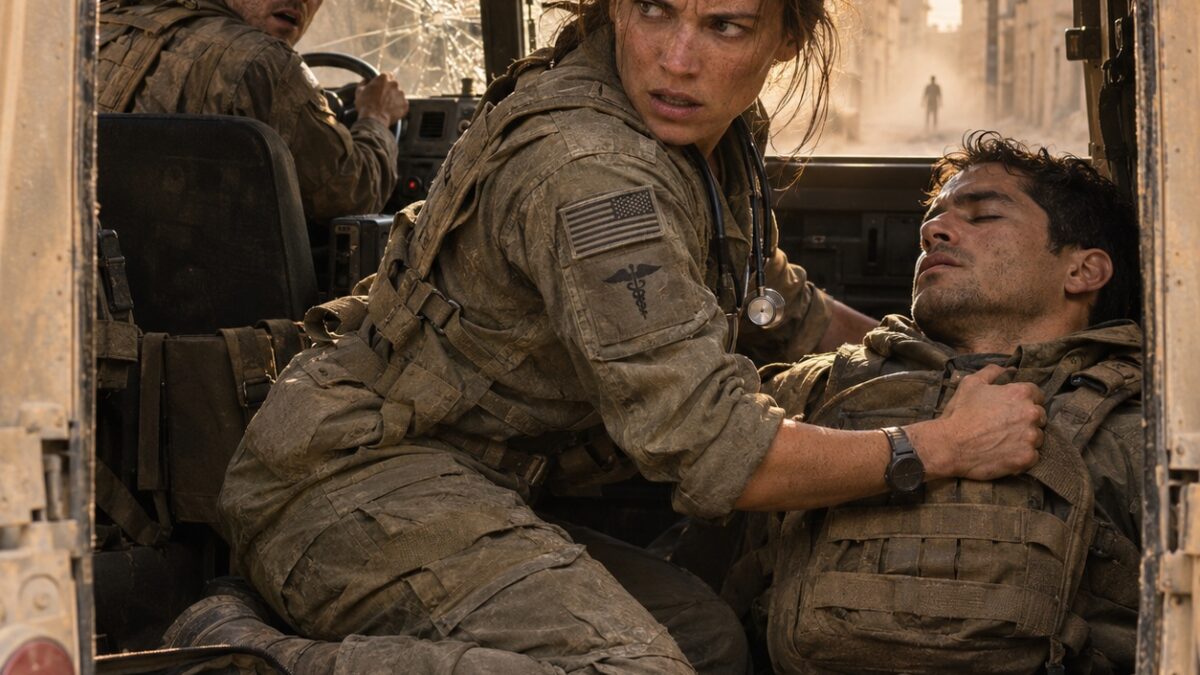
We made it back to the Humvee in pieces, a few people at a time. Somebody took the keys from me. I climbed in beside Eli. The man with the leg injury had dragged himself sideways across the floor to leave us room. He kept apologizing because he couldn’t move any farther.
“Stay right there,” I told him. “You’re fine where you are.”
Owen had just gotten behind the wheel when he looked past me through the open rear door. I turned in time to see a figure come out between two buildings. I recognized what he was carrying before I could see his face.
“Kate,” Owen said.
He’d never used my first name on the radio, in a briefing, or in front of the men. The way he said it made me realize he’d seen exactly what I’d seen.
There was a rocket launcher pointed at the back of our Humvee. Eli was still on the floor between my knees.
I grabbed the back of Eli’s vest and pulled him closer to me. There was nowhere inside the vehicle I could put him that would make him safe. I did it anyway.
One of Owen’s men shouted. The gunfire came so sharply I felt it in my teeth. The figure disappeared from the opening between the buildings. Something heavy struck the dirt. I never saw the launcher again.
The last man outside scrambled in. I caught the back of his belt and hauled until he was clear of the door. Owen drove. A crack spread across the windshield, stopped, then branched in two directions. A hot line opened up along my shoulder. I noticed it because it made it harder to get my bag out from under somebody’s boot.
“Everybody in?” Owen yelled.
The man I’d pulled aboard counted out loud. He touched each person he could reach as he did it. When he got to Eli, he said the number twice.
Eli’s breathing had changed. I asked Owen how far we were from the landing zone.
“Two minutes.”
I looked down at Eli. He’d shaved that morning and missed a spot below his left ear. I remember wanting painfully, absurdly, to be back at the medical tent where I could tell him about it and hear him say he’d done that on purpose.
Then I opened my bag. I asked the man beside me to hold it steady. He braced it with both hands while I secured Eli’s airway in the back of the moving truck. When I needed help keeping his breathing going, I told him what I needed and he did it. His hands shook when I handed him the equipment. They settled as soon as he had something to do.
The helicopter was touching down when we reached the landing zone. We transferred all three injured men. I gave the flight medic a rundown on Eli, and he repeated the important pieces back to me. I was grateful for that. The noise was so loud I could barely hear myself, and I wanted to know that everything I’d said had made it across the space between us.
I stepped away when they told me to. As the helicopter lifted off, I realized I was still gripping the strap of Eli’s empty stretcher. One of the crew had left it on the ground after moving him to theirs. I bent to set the strap down flat because it was the only thing left that I could put right.
Owen came up beside me.
“You heard them tell you to stay back?”
“Yes.”
“Did you hear them tell you to come back?”
“Yes.”
He nodded as if I’d confirmed something he needed for his report. Then he put a hand on the shoulder that wasn’t hurt.
“We got five people out,” he said. “I need you to hear that before anybody asks you about the rest of it.”
Back at the base, someone cleaned and dressed my shoulder. I asked whether there was word on Eli. There wasn’t. The corpsman who taped the dressing told me he was going to check again when he finished. I thanked him and made myself sit still while he pressed down the last corner.
Colonel Martin Shaw was waiting outside the operations building. He asked me to come to his office. I went with the dressing under my shirt and a line of dust across my forearm where I’d leaned against the Humvee door.
There were two envelopes on his desk. He kept his hand on the first one while he asked me whether I’d understood the order.
“I understood it, sir.”
“And you left anyway.”
“Yes, sir.”
He waited. I realized he was giving me a chance to say more.
“I thought Navarro would stop breathing before anybody could reach him,” I said. “I thought I could get to him in time.”
“You could’ve sent us after six people.”
“I know.”
“Did you know that when you took the truck?”
I took longer to answer that one. I had understood it in the operations room. I had let myself think about it for perhaps a second as I walked out. Then I had thought about Eli. I told Shaw all of that.
He leaned back far enough for the chair to creak. “I’ve got your service record here. Twelve years without a disciplinary entry. I’ve also got a request to refer this for court-martial.”
I kept my hands on my knees. The dressing felt too tight whenever I took a breath.
“In the other envelope,” he said, “I have Lieutenant Commander Beck’s recommendation for the Navy Cross.”
I looked at the envelopes again. I’d assumed one was a copy of the other.
“What do you make of that?” he asked.
“I make out that he got back here and wrote it before he knew how Navarro was doing.”
Shaw looked at me for a long moment. “Navarro’s alive. He made it to surgery. That’s the update I have.”
I let my eyes close. I’d been waiting to hear that from the minute the helicopter left. I hadn’t realized how much it would matter to hear it from the person who was about to decide what happened to me.
Shaw slid the first envelope across the desk. I’d receive a written reprimand for disobeying a direct order. It would go in my record. He would also forward Owen’s recommendation and add his own account. I asked whether I needed to sign anything that evening. He gave me a receipt acknowledging that he’d handed me the letter. I signed it.
At the door, he called my name.
“The next time we have a team out there, I want to know what we can give you short of asking you to sit in a room and listen.”
I turned back. “I’d like to be in that conversation, sir.”
“You will be.”
That evening Owen found me putting supplies back into my bag. I had counted the same stack of dressings twice. He sat down across from me and took the one unopened package I’d set aside to check.
“The guy on the radio was thinking about the rest of us, too,” he said. “We all know what it means when the only person who can do your job goes out the door.”
I took the package from him. “I used to think you kept me back because you figured I’d get in the way.”
“Sometimes I keep people back because I want them there when we get home.”
He said it plainly. He’d been close enough to see that launcher from the driver’s seat. I thought of the way he’d said my name.
“I heard you, Owen.”
He rested his elbows on his knees. “Good. I don’t think I’ve got it in me to say it twice.”
The other two injured men recovered first. Eli took longer. For a while the updates were all in somebody else’s voice. He’d made it through another procedure. He was awake for a little longer each day. He’d asked where he was. By the time I heard his own voice on the phone, I’d gotten so used to saying his last name that I nearly called him Navarro when he said hello.
He told me he couldn’t remember the ride. He remembered breakfast, a few things from before he got hurt, and coming awake somewhere with a clean pillowcase. He asked whether he’d made a lot of noise while we were carrying him.
“You were pretty quiet,” I said.
“I guess that explains why everybody else has a better story than I do.”
We laughed, and then I could hear him trying to find words for something. I sat at my desk and waited. After a while he asked how my shoulder was. I told him it was healing. He said good. That was all either of us could manage that day.
Three months after the rescue, we gathered in a small room in Virginia Beach. All five men were there. Eli stood with the others until somebody brought him a chair and Owen told him in a low voice to take it. He did. I kept looking over at him while Colonel Shaw read the citation. I had spent a long time trying to picture him sitting up on his own. Now there he was, leaning down to straighten the crease in his trouser leg.
Shaw pinned the Navy Cross on my uniform. Afterward, while the others shook my hand, Eli waited by the chair.
“Everybody keeps telling me you came to get us,” he said when I reached him. “I wanted to tell you myself that I got home.”
I knew he’d been back to see his family. Hearing him say it was different. I put my hand out and he took it, then covered it with his other hand when he felt it tremble. We stayed like that until he was ready to let go.
That night I put the medal case on my desk beside the reprimand. I read the reprimand all the way through. I could still hear the operations officer telling me to turn around. I could hear Owen counting on the radio. There was room in the drawer for both, so I put them there together.
Before I left the office, I refilled the medical bag and set it by the door. A message had come in from Eli while I was working. It was a picture from his mother’s kitchen. Somebody had put too many chairs around the table. Eli was in the one nearest the camera, with a paper napkin tucked into his collar and a piece of pie twice the size of anybody else’s.
I enlarged the picture until I could see his face. He was laughing at somebody just outside the frame. For the first time in months, when I thought of Eli, that was the sound I heard.