I Donated Blood to Save a Stranger After a Crash. When He Woke Up, He Asked for My Mother’s Name. Then His Son Locked the Hospital Room Door and Held Up a Phone That Would Tell Me Why I’d Grown Up Without a Father
The first thing my father ever asked me was how old I was.
The second was whether my mother’s name was Evelyn.
I still had the cotton taped to my arm from giving him blood. Until he dropped his water glass, I thought I’d come back to the hospital to let a stranger thank me.
I was nineteen and working at a garage in South Tacoma, where my boss let me use the lift after closing to keep my mom’s Buick running. Every time I fixed something, she’d ask how much she owed me. Every time, I’d say, “Fifty bucks,” and she’d hand me a sandwich.
That was how things worked between us. We kept a running joke about money because keeping a running total would’ve been depressing.
I was at the hospital that morning to pick up her test results. She’d been too dizzy to finish a shift at the diner, and she’d started carrying a chair around the kitchen so she could sit down between orders. She thought I didn’t know about the chair.
Near the elevators, a man about my age was on the phone.
“Offer five thousand,” he said. “Ten. I don’t care. Just get somebody here.”
His mother was standing beside him in a cream coat, holding a pair of men’s glasses. One lens had a crack straight across it.
I heard enough to learn there’d been a wreck on I-5 and that the hospital blood bank needed donors with a rare type. I knew mine from a high school blood drive.
“I think I’m a match,” I said.
The woman’s eyes went from my face to my work boots. “How much do you want?”
I honestly thought she’d asked how much blood I could give. I looked down at my arm.
Her son said, “She means money.”
“Oh,” I said. “No.”
The blood bank screened me and confirmed I could donate. Later, a nurse told me the man had made it through surgery. I was on my way out when his son caught up to me with an envelope.
“It’s two thousand,” he said. “You could get yourself a decent pair of boots.”
I looked at the duct tape around my left toe. Mom had wrapped it herself the night before, pulling it tight while I balanced on one foot in our kitchen.
“They’ll hold,” I said, and handed back the envelope.
Two days later, the hospital called. The patient, Richard Mercer, had woken up and wanted to thank me. I recognized the name immediately. MERCER CONSTRUCTION was printed on half the jobsite fences I passed on the bus.
I went after work. His wife and son were already there. I’d learned their names by then, Claire and Luke. Luke stood up when I came in. Claire stayed by the window, polishing those cracked glasses with the hem of her shirt.
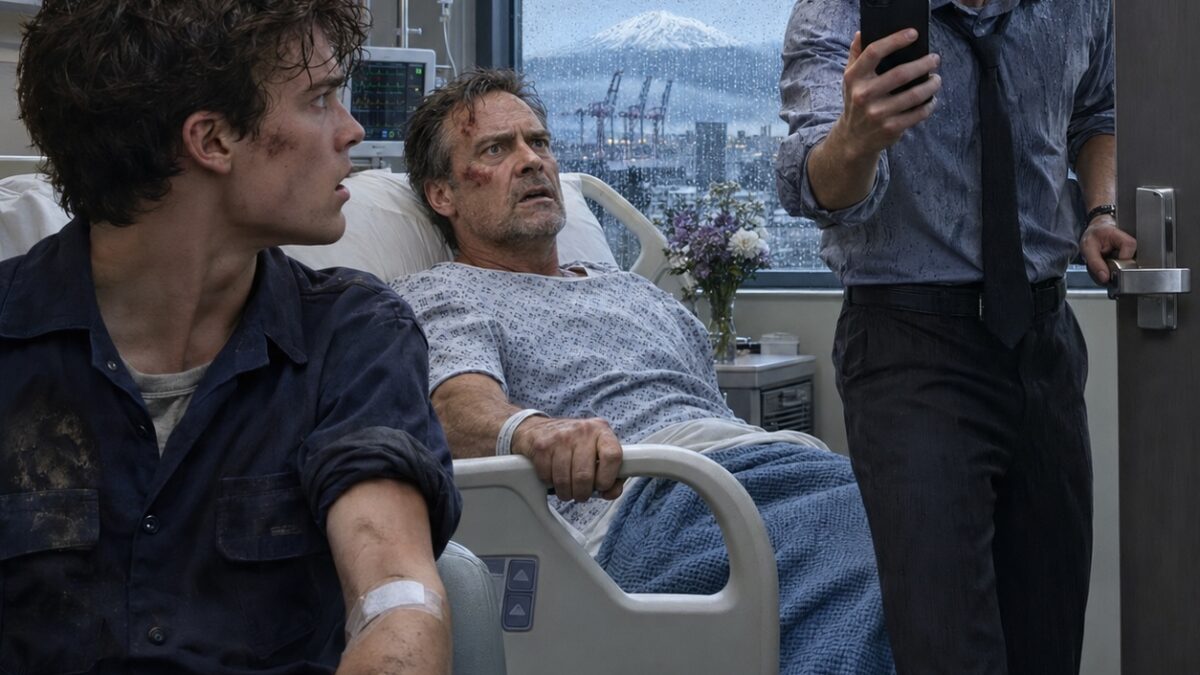
Richard had a glass of water halfway to his mouth. When he saw me, it slipped out of his hand.
“How old are you?”
“Nineteen.”
He stared at the little mole under my left ear. Then he reached up and touched the same spot on his own neck.
“Is your mother’s name Evelyn?”
I stopped reaching for the towel I’d been about to use on the spill.
“Evelyn Bennett,” he said. “She used to spell it out for people because they always left off the second T.”
Nobody outside our family knew that about my mom. I could hear her saying it in my head, patient on the first try and less patient on the second.
“What do you want with her?”
Richard pressed both hands over his eyes. His shoulders started shaking. Claire picked up her bag and told me it was time to go.
“Sit down, Claire,” he said.
She walked out. Luke followed her, and Richard asked me to call my mother. I did it because I wanted to hear her tell me there was a simple explanation.
“Mom? I’m with the guy from the accident. Richard Mercer.”
I could hear a fork clatter against a plate. She was at work.
“Cal,” she said, “get out of that room.”
Richard leaned toward the phone. “Evie, they told me you lost the baby.”
My mother went quiet. When she finally answered, she spoke so softly I had to move my phone closer.
“Ask Claire what she did with the papers I signed the night my son was born.”
The door opened. Luke came in alone. He turned the lock and held up his phone. His hand was shaking so badly I could hear his wedding ring clicking against the case.
“I recorded Mom in the hallway,” he said. “Dad, she just told Uncle Paul to burn the paper with your signature on it.”
Luke tapped the screen. For a second there was only the rumble of a cart rolling down the hall. Then Claire’s voice came through.
“The one Richard signed, Paul. Yes, the hospital release. Evelyn’s signature is underneath his.” A pause. “Because the boy is standing in his room.”
My mom was still on speaker. I looked down at the phone in my hand. The call timer kept ticking.
“Mom? What did you sign?”
“Come home,” she said. “I’ll tell you myself.”
Richard pulled at the bed rail as if he could get up and follow me. He made it about an inch before his face went gray.
I went to the door anyway.
“Cal,” he said.
It was the first time he’d used my name. I stopped with my hand on the lock.
“I signed papers that night,” he said. “I didn’t read them.”
I looked at him.
“You ought to know that before you go,” he said.
Outside, Claire was waiting for the elevator. There was a faint red dent across the bridge of her nose. At some point she must have put on her husband’s broken glasses.
“Your mother got what she asked for,” she told me.
“What did she ask for?”
The elevator opened. Claire held the door with one hand. For a second I thought she might actually answer me.
Then she stepped inside.
At home, Mom had changed out of her diner uniform and put on the sweatshirt she wore when she was sick. She sat at the kitchen table with a shoebox in her lap. I recognized it immediately. It had been on the top shelf of every closet in every apartment we’d ever lived in. Once, when I was little, I’d asked what was inside. She’d told me, “Grown-up things.” I’d assumed she meant tax returns.
She took out a hospital bracelet small enough to fit around two of my fingers. It said BABY BOY BENNETT.
“Richard and I were together for eleven months,” she said. “He was separated from Claire. Luke was almost two. We talked about how the boys would have to get used to sharing toys.”
She rubbed her thumb across the bracelet.
“When he went back to her, he said he’d still come when you were born. I called him from the hospital. I called twice.”
Claire had arrived that evening with her brother Paul, an attorney who handled work for the construction company. Mom remembered that he’d carried a paper cup of coffee. He’d put it on the tray beside her untouched dinner and pushed the tray across the bed so she could sign.
“They said Richard wanted you released to him,” she said. “Paul showed me where he’d signed. I kept asking where Richard was. Claire told me he was downstairs in the car.”
“Was he?”
“I believed he was.” She laid the bracelet on the table. “At three in the morning, that was enough.”
Claire had offered her a way out. If Mom agreed to leave Richard alone and keep his name off the birth certificate, Claire would tear up the release. If she fought, Claire said they’d use everything they knew about her. No insurance. Late rent. A father she hadn’t spoken to in years. Mom was twenty-three, and she’d just had a baby. She believed a courtroom would look at her and see exactly what Claire saw.
“I signed where Paul pointed,” she said. “Then I asked the nurse if I could hold you until they made me leave. She said, ‘Honey, you’re both going home tomorrow.’ I kept asking her if she was sure.”
“Did they give you a copy?”
“No. I wrote down everything I could remember when we got home. I was scared I’d wake up and decide none of it had happened.”
She pulled a diner order pad out of the box. On the first page, in the same handwriting she used to leave grocery lists on the fridge, she’d written Richard downstairs? Ask nurse if he came up.
I had to look away from that question mark.
“Why didn’t you ever tell me?”
Mom folded her hands on the table. “When you were eleven, you made that birdhouse in shop class. You asked if I knew where you could send it for Father’s Day.”
I remembered painting the roof green. For years I’d thought I’d imagined making it for him.
“I had his office address right there in my purse,” she said. “I told you I didn’t know where he was.”
“I waited all night for you to change your mind.”
“I know. You left the porch light on.”
She reached into the box one last time and lifted out the birdhouse. A little of the green paint had flaked off where the roof met the wall. I’d spent a whole Saturday getting those two pieces to line up.
“I should’ve told you while you still wanted to ask,” she said.
“I still want to ask, Mom.” I slid my chair over until our knees touched. “I just have more questions now.”
Luke called the next morning. He’d reached Paul before he could get into the safe. He told him about the recording and said that if the papers disappeared, he’d send a copy to every partner at Paul’s firm. By lunchtime, Paul had sent scans to all four of us.
There were two pages. The first authorized the hospital to release me to Richard. The spaces for my name and date of birth were blank. His signature was at the bottom. The second page was the agreement Claire had offered my mother. Her signature wavered and stopped halfway through the final T.
Mom put one finger on each page. “I was supposed to get this one back,” she said, touching the release.
We asked Richard to meet us at the garage the week he got out of the hospital. It was the only place I could think of where I wouldn’t feel like somebody else’s guest. Luke drove him. Claire arrived separately. I’d told Luke to invite her because I wanted her to hear every question I asked Richard, and I wanted him to answer with her there.
Richard lowered himself onto a shop stool. Mom laid the two pages on the workbench. The door was open, and every so often a car went by on the wet street.
“Were you downstairs?” she asked him.
“No,” he said. “I was home with Luke.”
Claire closed her eyes.
Richard said he’d heard both messages. On the first, Mom had told him she was in labor. On the second, she’d said she was scared and asked him to come.
“Claire said Paul could handle it. She brought me a stack of papers to sign. I remember thinking if I went to the hospital, I’d have to tell you myself that I was going back to her. So I signed the papers and stayed home.”
“What did you think Paul was going to handle?” Mom asked.
Richard looked at the two pages. “I thought he’d get you to stop calling.”
The refrigerator in the break room clicked off. I’d worked in that garage for three years and had never heard it go quiet.
“The next morning,” he said, “Claire told me you’d lost the baby. I asked if you wanted me to come. She said you wanted me to leave you alone.”
“When did you stop thinking about calling me yourself?” Mom asked.
He sat with that for a while.
“Your birthday,” he said. “It was about two months later. I picked up the phone at work. I put it back down because I was afraid you’d answer.”
Claire stepped closer to the bench. “I’d found an apartment listing in his coat pocket,” she said. “Two bedrooms. He’d written Luke’s name beside one and ‘baby’ beside the other. I thought he was going to take my son and build a family with you.”
Luke had been leaning against the tool chest. He straightened up.
“You told me Dad and I had never spent a night apart,” he said. He was looking at his mother, and I got the feeling this was something she’d said to him more than once.
Claire reached for him. He put both hands in his pockets.
Mom picked up the release. “I need to hear you say what you came there to do.”
Claire looked at the signature. “I came to make you think I could take him.”
“And afterward?”
“I told Richard the baby died.” She put a hand flat on the bench to steady herself. “I had nineteen years to tell him he hadn’t. There were nights when I lay next to him practicing how to say it. In the morning I’d get up and make coffee.”
I thought of her in the waiting room holding those broken glasses. She had been scared of losing him that morning. She’d been scared nineteen years earlier, too. And my mother had spent the first night of my life asking strangers how long she’d be allowed to hold me.
Mom folded the papers and tucked them into her bag. Claire asked if she could call her sometime.
“I’ll let you know if I want to hear from you,” Mom said.
Then she turned to Richard. “When you talk about what happened, tell people I called twice.”
“I will,” he said.
Mom went out to the Buick. Richard stayed on his stool. The fluorescent light above him was flickering. I’d been meaning to change it for weeks.
“What happens now?” he asked.
“I’m going home with my mom.”
He nodded and reached for his coat. He was having trouble getting one arm into it. I almost stepped forward. Then Luke came around the bench and held the coat open for him.
A few weeks later, Richard and I took a paternity test. We opened the results in the same kitchen where Mom had shown me my hospital bracelet. Richard asked if I wanted to read them aloud. I said he could. He got as far as my full name and had to set the page down.
I kept Bennett. I also kept the envelope he mailed me afterward. Inside was a letter that began with the two calls he’d ignored. Near the end, he’d written down the things he remembered about Mom before everything went wrong. The way she sang along to the radio when she thought a song was almost over. How she always ordered a piece of pie with two forks because she wanted company even when she wanted the whole piece. I read those parts to her over breakfast. She laughed at the one about the pie. Then she asked me to read it again.
Luke came by the garage one Saturday with a headlight out. I showed him how to change the bulb. He held it by the glass after I’d just told him to hold it by the base, and we had to clean off his fingerprints.
“Do you think we would’ve gotten along?” he asked.
“At what age?”
He thought about it. “Any.”
I handed him the bulb again. “You would’ve gotten me in trouble.”
“Yeah,” he said. “I think I had a few good years in me.”
By spring, Richard and I were meeting for breakfast at Mom’s diner every other Sunday. The first few times, he wore a jacket and arrived early. I wore my garage sweatshirt and arrived whenever I got there. Sometimes Mom brought our coffee. Sometimes she traded tables with somebody else. Richard learned to say good morning and let her get on with her shift.
One Sunday he was meant to help me replace the Buick’s busted window motor in my driveway. I was eleven minutes into deciding he wasn’t coming when he pulled up with a raincoat and the wrong part. I made him go back to the store. He came back with the right one, plus two coffees, and held the window glass in place while I bolted the motor in.
Mom came out in slippers to try it. She sat behind the wheel and ran the window up and down three times. Then she reached into the back seat and brought out two foil-wrapped sandwiches.
“How much do I owe you?” she asked me.
“Fifty bucks.”
She handed me a sandwich. Then she held the other one out to Richard.
He took it with both hands. There was grease on his cuff and rain coming off the tip of his nose. When Mom went inside, he stayed under the raised garage door with me and ate every bite.
The garage was still open when it started getting dark. Richard reached for the switch on his way out, then stopped.
“Do you want me to leave the light on?”
I thought about the green birdhouse. It was still on the kitchen counter. I hadn’t decided what to do with it yet.
“Leave it on,” I said. “I’ll see you Sunday.”