An Old Labrador Wrapped His Paws Around My Neck on a Burning Bridge in Oregon. I Carried Him Back Before It Fell, but When the Vet Asked Me to Stay, I Finally Had to Face What I’d Been Running From. aviet7
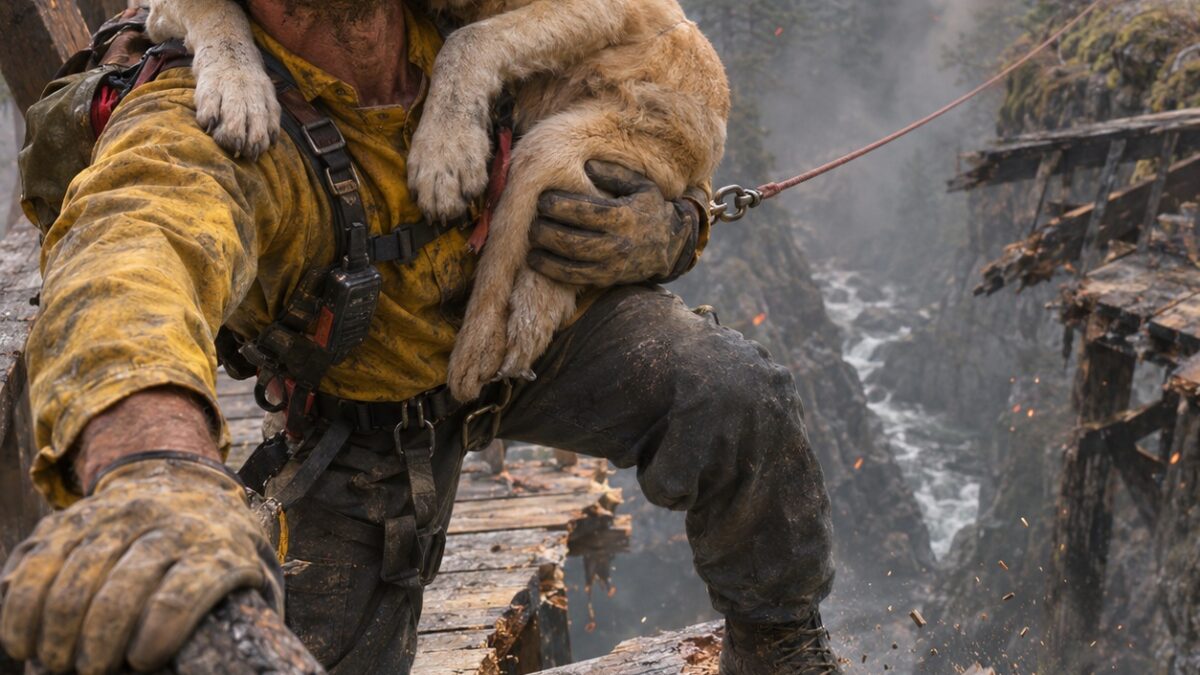
The old Labrador put both front legs around my shoulders just as the bridge dropped beneath my left boot.
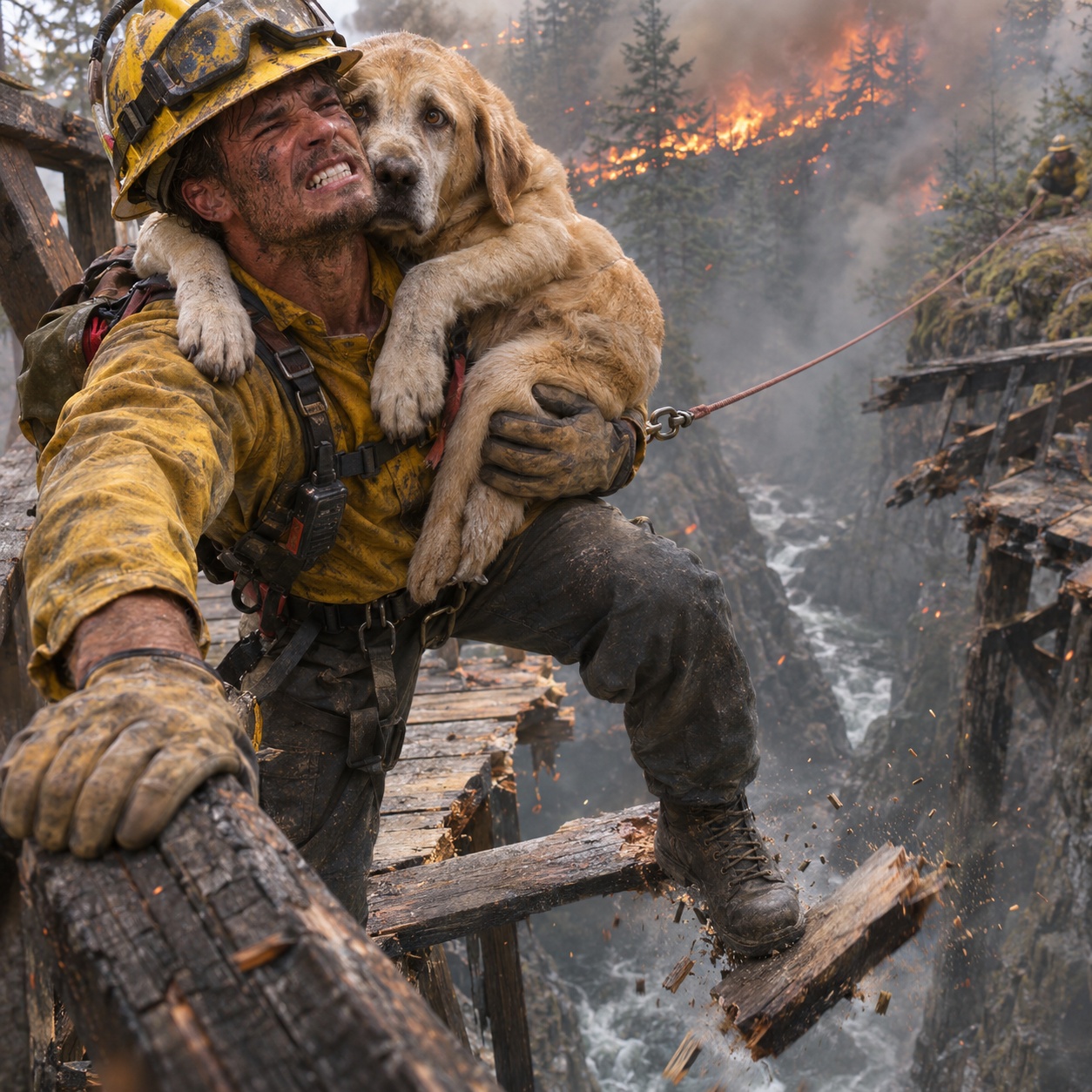
I caught myself against a timber and felt him bury his face in my neck.
“Hold on,” I said.
He already was.
My name is Owen Hale. I was thirty-four that summer, eleven years into fire and rescue, and still in the habit of telling people I was fine before they asked. My partner, Mateo Ruiz, had learned to ask anyway. That morning, on the east side of Oregon’s Cascades, he handed me half a breakfast burrito and waited until I took a bite.
“You ate dinner yesterday?”
“I think so.”
“Name a food.”
I couldn’t. He handed me the other half.
The wildfire had been burning for three weeks. We were checking properties along the evacuation route, including a handful of homes across Alder Creek. I knew the road from riding it with my dad when I was a kid. He used to roll down his window over the old wooden bridge so we could hear the tires hit every board.
I hadn’t driven it since his funeral.
Now the bridge was burning from the middle out. We stopped short of the approach. I was trying to see whether the far bank was clear when a section of deck broke loose. The noise came up out of the gorge and went on long after the wood disappeared.
Then I heard a bark.
Mateo turned his head. He’d heard it, too.
Through a break in the smoke I saw a yellow dog on the far section, pressed against the rail. Beyond him, the deck had pulled away from the bank. The old dog raised his head and made the sound again. It was small enough that I could have mistaken it for something rubbing against the wood.
Our crew chief called it in and sent another unit toward the far bank. They had miles of back roads between them and that dog. We had the gorge and what was left of the bridge.
Below the broken deck, a side support still ran across the gap. Mateo followed my eyes.
“Owen.”
“I see it.”
“I know you see it. Look at me.”
I did. There was ash on his eyelashes. He asked me to tell him what I thought I could reach and what I’d do if the rest of the deck shifted. I answered the first question. The second one took me longer.
By the time I moved, the crew knew where I was going. Mateo stayed on solid ground with the line. He told me he was there once, quietly, before I started across. I could hear him breathing over the radio.
Halfway out, the dog stopped barking.
I called to him. Nothing.
Then I climbed high enough to see his ears. One lifted at my voice.
He was a big yellow Lab, gray all around the mouth. The fur along his side had curled from the heat. He tried to stand as I approached, got halfway there, and sank back against the rail.
“Hey, buddy. You can stay right there.”
I reached beneath his chest. His paws came up before I could lift him. One landed on my shoulder, then the other, and suddenly I had the full weight of his head against my neck.
I could feel his heart through my jacket. For a second I thought of the last time my dad had reached for my arm. I’d told him I was getting coffee and would be right back. We both knew the cafeteria was closed.
The bridge shifted. My boot slipped. The dog held tighter, and I put my arms around him.
“I’ve got you,” I said.
Then I had to make good on it.
I remember the heat beneath us and the old dog’s breath beside my ear. I remember looking up at Mateo and watching him move his mouth before I could make sense of his words. The last stretch felt twice as long coming back. I could see the dirt on the bank, close enough to count individual pebbles, and still couldn’t put my foot on it.
Then Mateo grabbed my coat and pulled.
We landed hard. The dog was still against my chest when another section of the bridge went down. I never turned to see which one.
At the ambulance, a paramedic asked what to call him.
“Boone,” I said, surprising myself.
She put a folded blanket beside my boots and reached for him. Boone’s head slid off my shoulder. His legs fell loose.
Then she put her hand against his chest and said, “Owen, let go. I can’t feel him breathing.”
I opened my arms. The paramedic slid Boone onto the blanket, called for the oxygen kit, and bent close to his face. I kept my hands in my lap because there was nowhere else to put them.
“Wait,” she said.
A moment later I saw the fur move along his ribs. Once. Then again.
“He’s breathing. It’s shallow.”
Someone set the kit beside her. Mateo took my arm and moved me back a step so she could work. I’d spent years asking people to give us room. I understood exactly why they always wanted to take that step forward again.
A veterinarian was seeing evacuated animals at the county fairgrounds. One of our crew drove Boone there in a support rig. Mateo took me separately after the paramedic checked me over. On the way I noticed ash in the crease of my wrist. I wiped it onto my pants, then did it again where there wasn’t any ash left.
“Did you hear me on the radio?” Mateo asked.
“Most of the time.”
“I kept asking you to tell me when you were coming back.”
“I was trying.”
“I know.” He kept his eyes on the road. “From where I stood, there was a whole stretch where I couldn’t see either of you.”
I’d spent the last twenty minutes thinking about what had happened to me. It was the first time I pictured him on the bank, holding a line that went into smoke.
At the fairgrounds, folding tables divided a livestock building into treatment areas. A woman in muddy jeans was trying to coax a goat out of a horse trailer. Inside, someone called for another blanket. The ordinary sounds helped until I saw Boone lying behind a temporary screen with his paws wrapped and his eyes closed.
Dr. Nora Ellis, the veterinarian, came out to tell me what she knew. He’d been breathing smoke. His paws were injured, and he was tired enough that she wanted to keep him under close watch. She couldn’t tell me how he’d be doing by morning.
“Did he have a collar?” she asked.
“If he did, it was gone when I got there.”
She’d already checked for a microchip. There was none she could find. A volunteer took a picture for the reunification board and asked me to fill out a card.
I wrote yellow Lab, male, older. Under identifying marks I put white spot under chin, then crossed it out because his whole chin was white.
The volunteer said she’d leave the name blank.
“Put Boone,” I said. “In parentheses, maybe.”
Mateo brought me water and told me the chief had taken us off the line for the rest of the shift. I said I could get a ride back to my apartment. I had a fresh uniform there. I could shower, put my gear away, and be ready when they needed me.
Behind the screen, a claw scraped against the floor.
“Would you sit with him a while?” Dr. Ellis asked. “He lifted his head when you spoke.”
I looked at Mateo, expecting him to tell her how much else there was to do.
“I’ll save you a sandwich,” he said, and walked out.
I took the chair beside Boone’s blanket. His eyes opened a little when I sat. I reached for his shoulder, then remembered how sore he might be and laid my hand flat where he could see it.
After a minute he put his nose against my knuckles.
“Hey,” I said.
I didn’t have anything else ready.
My dad had asked me to stay with him on his last night in the hospital. He’d been asleep most of the afternoon. When he woke up, the ball game on TV was over, and he asked how long I’d been there. I told him I’d just gotten in. I’d actually been in the chair for four hours.
“Stay awhile,” he said.
Then he tried to get comfortable and couldn’t. I called the nurse. She came in and spoke to him, and while she was there I went looking for coffee I knew I couldn’t buy. I walked down to the lobby, out through the sliding doors, and halfway around the parking lot before I let myself stand still.
My sister, Tess, called from upstairs.
I answered on the second ring. She said my name, and I knew. I made her tell me anyway.
For a long time I let myself remember the parking lot as the place where I’d gotten bad news. Sitting beside Boone, I remembered what I’d felt when I pushed through those doors into the night. Relief. I’d been relieved to be out of the room where my father needed me, and I’d spent two years trying to make that fact sound like something else.
Boone shifted. His nose moved away from my hand.
I thought about calling Tess. I almost sent her a picture instead. A picture would give us something easy to talk about.
I dialed.
She picked up and said, “Tell me you’ve evacuated.”
“I’m at the fairgrounds. I’m safe.”
I told her what had happened. She asked if the dog had a chance. I said the vet was taking it a little at a time.
Then I said, “Dad asked me to stay.”
The silence on the other end changed.
“I know,” she said. “He asked me, too, after you left.”
I put my free hand over my eyes.
“I should have come back sooner.”
“I wish you had.” She took a breath. “I was scared. I wanted you there with me.”
That hurt more than anything I’d imagined her saying. In every version I’d rehearsed, I’d been asking whether Dad had forgiven me. It hadn’t occurred to me to ask what I’d left her to do alone.
“What happened after I left?” I asked.
She told me the nurse had helped him get comfortable. She told me he’d kept trying to pull the blanket off his feet because he’d always hated having his feet covered. She’d moved it for him and stayed beside the bed. I knew the exact way she would have done it, folding the blanket back twice so it wouldn’t slide down again.
“I wish you’d told me,” I said.
“I tried once. You went out to move my car.”
I remembered that, too. Her car had been perfectly fine where it was.
So I stayed on the phone. After a while we talked about the game we’d watched with Dad that afternoon. Neither of us could remember who won. Tess remembered him complaining that the visiting pitcher took too long between throws. I remembered that he’d said it loud enough for the man in the next room to yell, “You tell him.”
It was the first time we’d laughed about him together since he died.
I heard Tess turn off her kitchen faucet.
“Do you want me to come sit with you?” she asked.
I looked down at Boone. His nose had found my hand again.
“Yeah,” I said. “I do.”
She got there after dark with two sweatshirts and the worst coffee I’ve ever tasted. She put a chair beside mine. When Boone made a soft, rasping sound, we both looked over at the vet. Dr. Ellis came to check him, and Tess kept her hand on the back of my chair until the exam was done.
By morning he was alert enough to turn his head when someone opened a container of food. By the next afternoon he wanted to stand. He needed help, and he seemed personally offended by it. I understood that better than I wanted to admit.
The volunteers kept his picture up while the county shelter handled the search for an owner. People came through looking for dogs they’d lost in the evacuation. One man spent a long time looking at Boone’s photo before he said his own Lab had a dark spot on the roof of her mouth. I asked if he wanted me to walk the row of pictures with him. We went to the end and started back at the beginning.
After the vet cleared Boone to leave the fairgrounds, the shelter let me foster him during the search. My apartment was upstairs, so Tess offered her spare room until he could manage steps comfortably. The first evening there, she brought me a plate and sat beside me on the floor because I’d promised Boone I’d stay where he could see me.
He recovered in increments. A trip to the back door. A slow walk to the mailbox. A morning when I reached for his harness and he arrived before I finished lifting it off the hook. I sent Mateo a video of that one.
He called me back.
“Are you getting any sleep?” he asked.
“Some.”
“How much is some?”
“Come over Saturday,” I said. “I’ll make breakfast.”
It was easier to say that than to answer. When he came, I answered anyway. I told him I kept waking up at the moment my boot slipped. He told me that when he woke up thinking about it, the dog was already on the bank and I was the one he couldn’t reach. We let the eggs get cold talking it through. At work, we’d already reviewed the rescue with our chief. This was the first time I’d asked Mateo what the crossing had cost him.
No one came forward to claim Boone. Once the shelter cleared him for adoption, I filled out the paperwork at Tess’s kitchen table. She checked the form after I signed.
“You put my number under emergency contact.”
“I thought you’d answer.”
She slid it back to me. “I would.”
By fall, Boone was taking the stairs to my apartment at his own pace. He liked to stop at the landing where the afternoon sun came through the window. The first few times, I stood with my keys out and waited for him to get up. Then I started sitting down beside him.
On a Sunday in October, Tess and I drove out to the lower end of Alder Creek. The road to the bridge was closed, so we went to the public turnout downstream, where Dad used to take us to throw rocks into the water. I brought a thermos. Tess brought one of his old folding chairs, which still took both of us to open.
Boone waded until the water reached his ankles. He stood there a while, watching something we couldn’t see. Then he came back, shook creek water all over my jeans, and lowered his head onto my knee.
My phone buzzed. A friend from the station was asking if I could take an extra shift. I looked at the water and at my sister in Dad’s chair. We’d brought lunch and hadn’t opened it yet.
I wrote back that I was with family.
Tess poured me a cup of coffee. Boone sighed and put more of his weight against my leg. I could have shifted him. My foot was going to fall asleep.
I set my keys on the rock beside me and stayed.