A Neighbor Sent Us Into an Abandoned House During a Snowstorm. I Found a Huge Dog Standing Over an Old Cat, With Bloody Tracks Across the Floor. Then the Dog Took the Cat in His Jaws and Walked Toward Me
My boot slipped in a dark smear just inside the dining room.
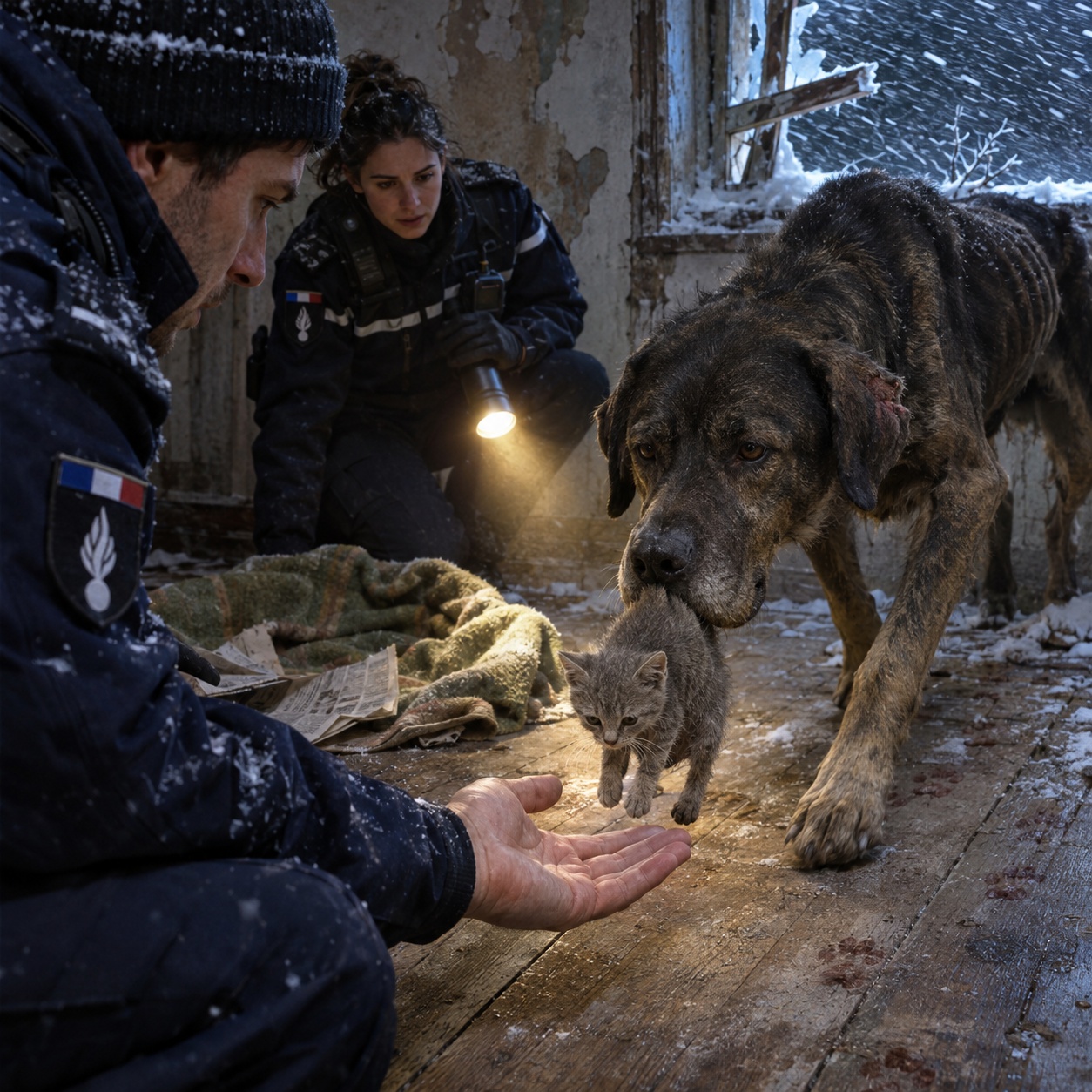
A dog the size of a small calf turned his head toward the sound.
Between his front feet lay a gray cat, its mouth slightly open.
Behind me, my partner whispered, “Can you get back to the door?”
I could have, if Claire moved first. The hallway was so narrow that her radio had already caught on a nail coming in. I put my hand behind me until I felt her sleeve, then nudged her back half a step. If the dog came at us, I wanted her to have room to turn.
I’m Julien Morel. I was a gendarmerie warrant officer outside Thionville, in northeastern France, and Claire and I had spent most of that night guiding drivers away from roads they could no longer see. We’d just helped a woman climb through the passenger window of her car when dispatch gave us an address on Rue des Forges.
The caller met us under a porch light across the street, wearing slippers inside plastic grocery bags. He said he’d heard a scream from one of the old workers’ houses. When he shone his flashlight through the window, he saw a big dog with something pinned beneath it.
“Did you see him bite it?” Claire asked.
“I saw the floor,” he said. “You’ll see it too.”
He kept looking over our shoulders as we talked. I took that for fear that the dog might get out.
Inside, snow had drifted over the threshold and halfway up the stairs. The front door dragged along the floor when I pushed it. I made sure it would stay open. Then we heard the dog, a low, even sound from the end of the hall.
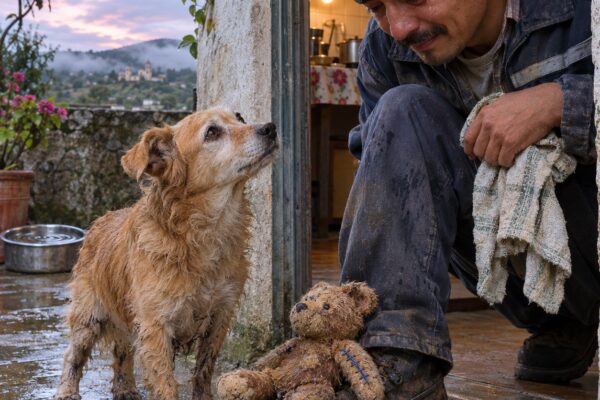
Now, with my light on him, I could see how much of his size was bone. His head was broad enough to fill both my hands, but his hips stuck out sharply. One ear had a healed notch. The fur along his shoulders lifted when I shifted my weight.
The cat lay on a heap of rubbish against the wall. I wanted to see its chest move. Every time I leaned far enough to get a better look, the dog moved with me.
Claire took her radio off her belt. I heard the dispatcher say the animal officer was across the district and the hill road was blocked. Claire lowered the volume before the reply was finished.
Then the cat made a sound. It was so faint I might have mistaken it for the wind in the window frame if the dog hadn’t reacted first.
His head swung down. I tightened my grip on the flashlight, ready to shout, and watched him lick the folded edge of the cat’s ear.
The cat’s jaw closed. A moment later, its head settled against the dog’s foot.
“Put your light on the floor,” I told Claire.
In the light reflected off the boards, I could see the pile beneath the cat properly. There was newspaper at the bottom, then a wad of insulation, then a piece of blanket folded twice. The outer edges of the pile were dusted white. The hollow where the cat lay was dry.
The dog shifted again and left a fresh red crescent on the blanket.
“Look at his feet,” Claire said.
The pads were split. One front paw shook whenever he leaned on it, and he kept picking it up and putting it down, as though he couldn’t find a way to stand that hurt any less. The tracks across the dining room went back and forth between the nest and a broken window at ground level. A strip of blanket, the same faded green as the one under the cat, hung from a jagged corner of the frame.
I took one glove off and set it on the floor beside me. The dog sniffed without lifting his head. Up close, the cat looked older than any cat I’d ever seen. One eye was gone, with a smooth line of skin where it had healed. The other was milky. When I moved my light across the boards, his good ear turned at the scrape of my boot, but his eye stayed fixed.
Whatever he could see, I doubted it was us. He knew exactly where the dog was.
“We’ll call the emergency vet,” I said. “Tell them we’re bringing two.”
Claire pulled a folded fleece from the top of her bag and opened it on the floor. I was looking for something stiff to slide under it when the dog dipped his head and gathered the loose skin at the back of the cat’s neck between his teeth.
The cat hung limp. Claire started to rise.
“Stay down,” I said.
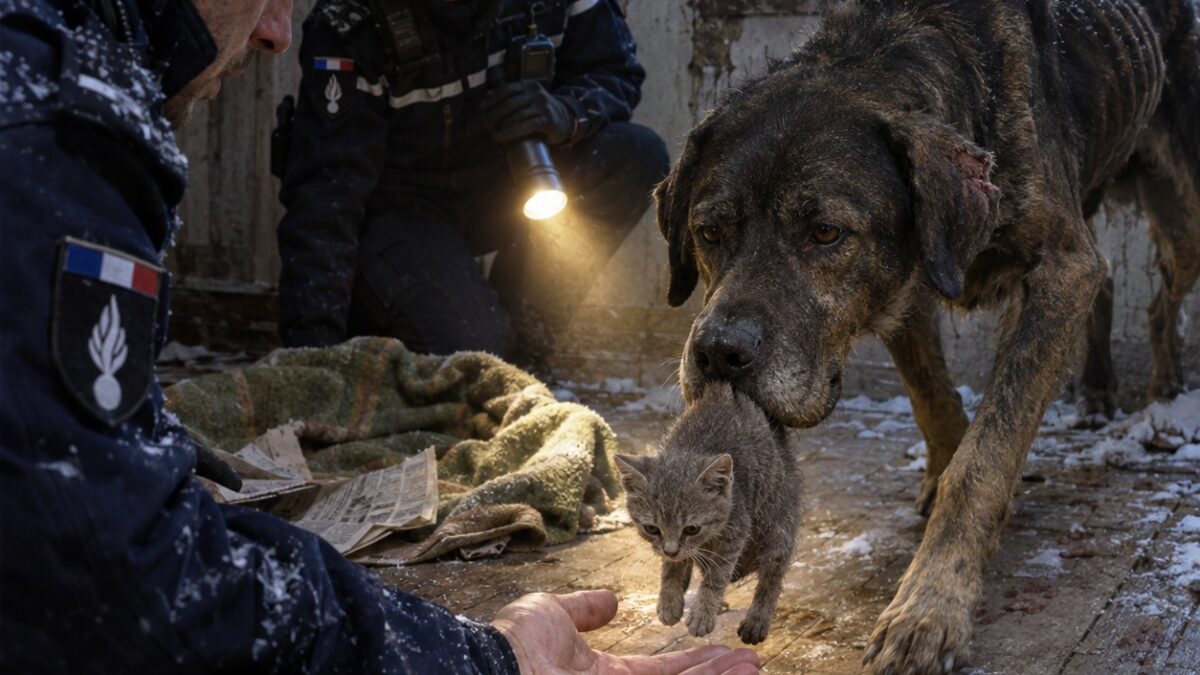
The dog took a step, then another. His bad foot slid on the boards. He caught himself, lifted the cat clear of the floor, and came straight toward my bare hand.
I turned my palm up and slid it under the cat’s ribs. The dog stopped so close that his whiskers brushed my wrist. For a second I held the weight of the cat with one hand while the dog still held the scruff. Then his jaw opened.
The cat weighed about as much as my wet coat.
“Bring the fleece here,” I said.
Claire slid it across the last few inches of floor. I tucked it around the cat, leaving his head exposed, and lifted him against my chest. The dog followed every inch of that movement. When I stood, he tried to stand with me and dropped hard onto one elbow.
Claire went out for the rescue blanket we kept in the back of the vehicle. While she was gone, I sat down again. The cat’s breathing was shallow enough that I kept putting a finger in front of his nose to feel it. The dog stretched his neck across my thigh and put his nose against the fleece. He stayed like that until Claire got back.
We spread the rescue blanket beside him. I eased the cat onto it first. The dog crawled far enough to get his front half beside the cat, then lay there panting while Claire worked the rest of the blanket under his hips. She counted to three. We got him off the floor, but the blanket sagged between us and his hindquarters bumped the doorframe. He gave one sharp bark. I felt Claire’s end drop an inch before she got her grip back.
At the threshold, the man in the grocery bags was waiting with a snow shovel. He’d cleared a path as far as the curb. It was barely wide enough for one of us, so Claire went backward and I followed, watching her boots to keep from stepping on them.
“Is that the gray one?” the man asked.
I stopped long enough for him to see the cat’s face.
“That’s Gus,” he said. His voice changed when he said the name. “I wondered where he’d got to.”
He held a flashlight while we lifted the blanket into the back of the vehicle. I asked him to save his number with dispatch. Then I climbed in beside the animals and told Claire the address of the clinic. She’d already called ahead.
Every time we went over a ridge left by the plow, the dog lifted his head to find the cat. I ended up holding the fleece against his nose so he could check without getting up. At one intersection Claire slowed to a crawl. A stranded delivery van had left room for us on one side, and I could hear the snow packed under our tires as we squeezed through. I kept my fingers at the opening in the fleece. Two blocks went by before I felt the next breath.
At the clinic, a vet named Sophie rolled a low table out to the vehicle. We slid the dog onto it with the cat still next to him. Under the lights in the exam room, Sophie put two fingers against the cat’s chest and asked an assistant to get a warming unit ready.
When the assistant lifted Gus, the dog planted his front feet and tried to follow. One paw folded under him. He went down with his chin on the metal rim of the table.
“Will you stay where he can see you?” Sophie asked me.
I took the fleece the assistant had set aside and held it under his nose. He breathed into it while Sophie examined his feet. Twice he pulled away when she touched the worst pad. The third time, I put my hand flat on the table next to his head. He laid his cheek across my fingers, and she got a dressing around the paw.
By then it was getting light. Claire brought in two coffees and set mine where my free hand could reach it. There was a message from the man on Rue des Forges. His name was Daniel. I called him while Sophie finished wrapping the dog’s other front foot.
Gus, he told me, had belonged to a woman named Madame Aubry who lived two doors down. Daniel used to carry her groceries in when the sidewalks iced over. In October, she’d gone to live with her daughter. Gus had disappeared the afternoon they loaded the car. Her daughter had come back several times to look for him. By the time Daniel spotted him at the empty house, he’d lost her number.
“Where does the dog come into it?” I asked.
“Around Christmas, I think. I went over to put a dish out and found him lying by the step. I moved the food farther away so Gus could get to it.”
“And did he?”
“Only after the dog went and got him.”
Daniel had seen it from his kitchen. The dog would push his head through the broken doorway, and a little later Gus would come out beside him. The cat walked with his whiskers brushing the dog’s front leg. At the dish, the dog would sit and wait. Some evenings Daniel found both bowls empty. Other evenings he was pretty sure the dog had gone hungry.
The night of the storm, the scream had brought him to the window. He’d seen the dog pulling something gray over the sill. His flashlight caught the blood on the floor, and he ran home to call us.
I thought about the torn strip of blanket on the glass and the tracks between the window and the corner.
“Was the blanket yours?” I asked.
“Yes. I put it in a box under the porch. I thought they’d get out of the wind in there.”
The wind had been blowing straight into that porch when we arrived. I remembered seeing a cardboard box flattened against the fence.
Daniel asked if he could come to the clinic when the road opened. Before hanging up he asked me to tell whoever needed to know that he’d called about the dog. He wanted the clinic to have the whole story. I handed the phone to Claire so she could take down what he’d seen for our report.
Sophie came back after a while and sat on the stool beside me. Gus was warming up, she said. She’d found no bite wounds. He was badly dehydrated and still too cold to tell how much strength he had left. When she said it could go either way, I looked down at the fleece. The dog had gathered a corner of it between his front paws.
I was due back at the station. Claire had already called to get us relieved, and she offered to take the vehicle in herself. I told her I’d find a ride home later. I hadn’t done much for the dog since we’d brought him in, but each time the exam room door opened and I shifted in my chair, he raised his head to see if I was leaving.
By late morning, Sophie was willing to bring Gus into the room for a few minutes on a warmed pad. I held the dog by a loose lead while she put the pad on the floor. He dragged himself forward until his nose was an inch from the cat’s face.
Gus didn’t move.
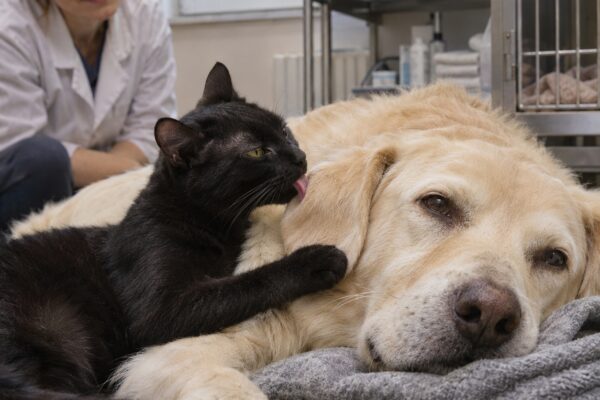
The dog sniffed under his chin. Then he licked his ear, the same tiny lick I’d seen in the house. I watched Sophie’s hand, waiting for her to lift the cat away. Instead, she took her hand off the pad.
Gus had lifted one paw. He reached until it touched the white dressing on the dog’s foot. His toes flexed once and went still. A little later he raised his head far enough to swallow a drop of water from Sophie’s finger. When she went for more, she waved me back into my chair.
That afternoon Gus ate half a spoonful of food. The dog finally fell asleep.
The city shelter took charge of the dog while his paws healed. They checked for a chip, posted a photo, and waited the required time for an owner to come forward. Nobody did. Sophie found an old clinic record for Gus, though, and reached Madame Aubry through her daughter. I was there when they brought her in. She wore a good wool coat with a safety pin where a button had come off. As soon as she sat down, she tapped the inside of her wrist twice with one finger. Gus lifted his chin. She slipped her wrist beneath it as easily as if they’d done it that morning.
She asked where the dog was.
“In the next room,” I said. “He gets up when he hears a dish.”
“Gus always did that, too,” she said. “Before his eyes got bad.”
When she saw them together, she asked her daughter to take a picture. At the door on her way out, she stood with one hand on the frame and told me the lease on her daughter’s apartment allowed one pet. She could take Gus that day if Sophie cleared him. Then she looked back into the room. Gus was asleep with his face in the crook of the dog’s leg.
“Do you have room where you live?” she asked me.
I had room. What I’d been thinking about was my shift schedule, the gap in my fence, and how I was going to get a dog that size to let me change a bandage by myself. I told her I could fix the fence before the end of the week.
Claire helped me do it on our next day off. She held the wire while I drove in staples and listened to me try out dog names. We settled on Bruno because it was the only one he’d looked up for at the clinic. When the shelter cleared his adoption, I brought both animals home. Madame Aubry came over on Sundays, and I kept a chair clear by the radiator for her. Gus could find her lap from the sound of her coat rustling.
The first few weeks, Bruno woke whenever the furnace clicked off. He’d cross the kitchen and put his nose into Gus’s bed. Sometimes Gus reached out a paw and caught him squarely in the face. Bruno would stand there until the paw slipped away, then go back to his own blanket. Eventually he started sleeping through the furnace. I knew because I’d started sleeping through it, too.
Gus lived until September. One morning he walked away from the saucer Madame Aubry had brought for him, lay down on the cool kitchen tile, and couldn’t get back up. Sophie came to the house. Madame Aubry held her wrist under his chin while Sophie worked, and I sat on the floor with Bruno. When it was over, we stayed there until Bruno had finished smelling Gus’s face and gone to lie down on his own.
I washed Gus’s saucer the next day. His bed stayed beside the radiator until the first frost. That morning, Bruno dragged the fleece he slept on across the kitchen and dropped it in my lap. I figured he wanted me to spread it out for him.
When I did, he turned in a circle and lay across my feet, with his head resting in my open hand.