A Freight Engineer Spotted a Tigress Beside the Tracks at Dawn. When I Found Thin Strands of Wire Caught Between Her Claws, I Asked the Rescue Crew to Go Back and Search the Ground Around the Railway
The tigress lifted her head just high enough to look at my boots. Then her chin dropped into the gravel.
Up on the railway, a loose buckle tapped against a rescue worker’s belt. I could hear it over her breathing.
“Did she do that when you got here?” I asked.
“She hasn’t lifted her head for anybody else,” he said.
My name is Lena Morozova. I was the wildlife veterinarian on call that morning in the Russian Far East. The freight engineer who spotted her had taken a dark shape beside the tracks for a fallen tree. Then the tree turned its striped face toward his locomotive. By the time I arrived, the dispatcher had stopped trains on that stretch and the reserve crew had cleared the embankment. There was a whole freight line waiting on an animal that could barely hold her head up.
Pavel, the crew leader, was the man with the buckle. We’d worked together long enough that he could tell by the way I set down my case whether he should come closer. That morning he stayed put.
“How much time do you need?” he asked.
“Ask them for an hour.”
He walked uphill to get a radio signal. I’d asked for an hour because it was a number I could give him. Looking at the short, shallow rise of her ribs, I was trying to decide whether she had ten minutes.
I watched her from the service path and prepared a sedative. Even weak as she was, she could hurt someone if she startled. I was worried about what the drug might do to her breathing, and I needed her still enough to examine and move. Once it took effect, Pavel and I went down together.
Up close, the first thing I saw was how dry her mouth was. The second was a front paw she’d tucked underneath herself. I eased it forward. A short strand of wire had worked its way between two claws. There was another strand wound around the tip of a claw on the other foot.
“Snare?” Pavel asked.
“Maybe. Help me turn her a little.”
He held her shoulder while I checked both legs. The cuts were shallow and scattered across the tops of her toes. I couldn’t find the band of damaged skin I’d expected from a loop pulled tight. I put the wire in a sample envelope anyway. It was all I had to go on.
We carried her up the slope in a transport crate. Halfway to the truck, my end slipped in my gloves. Pavel braced the crate against his thigh until I got my grip back. I remembered that later, how quietly he’d said, “I’ve got her,” while I fumbled with a handle I’d used a hundred times.
At the clinic, we got fluids into her and watched her come out of sedation. She was severely dehydrated, and once I could examine her properly, I could feel how little she had left on her. I tried to account for the last few days of her life. An infection might have kept her from eating. So might something she’d swallowed. The first tests gave me little to work with, and the wounds on her feet looked smaller each time I checked them.
I took the envelope out of my coat pocket. Under the exam light, one of the strands had a tight bend at the end, like a tiny hook. I thought about where I’d found the two pieces, on separate feet, and how many times a cat might put both paws against something before scraps of it got buried that deep.
Pavel was still at the railway when I called. He and his crew were packing up.
“Do you have the spot marked where she was lying?”
“I do. The dispatcher wants the line back.”
“Give them the line when it’s clear. I want you to look down the slope, in the brush. See if there’s anything she could’ve been digging at.”
There was a pause. “You think she got loose and came back?”
I looked through the glass at the tigress. She’d managed to shift about six inches toward the water dish. Her chin was on the floor again.
“I’d like to know what was worth tearing up both front feet for.”
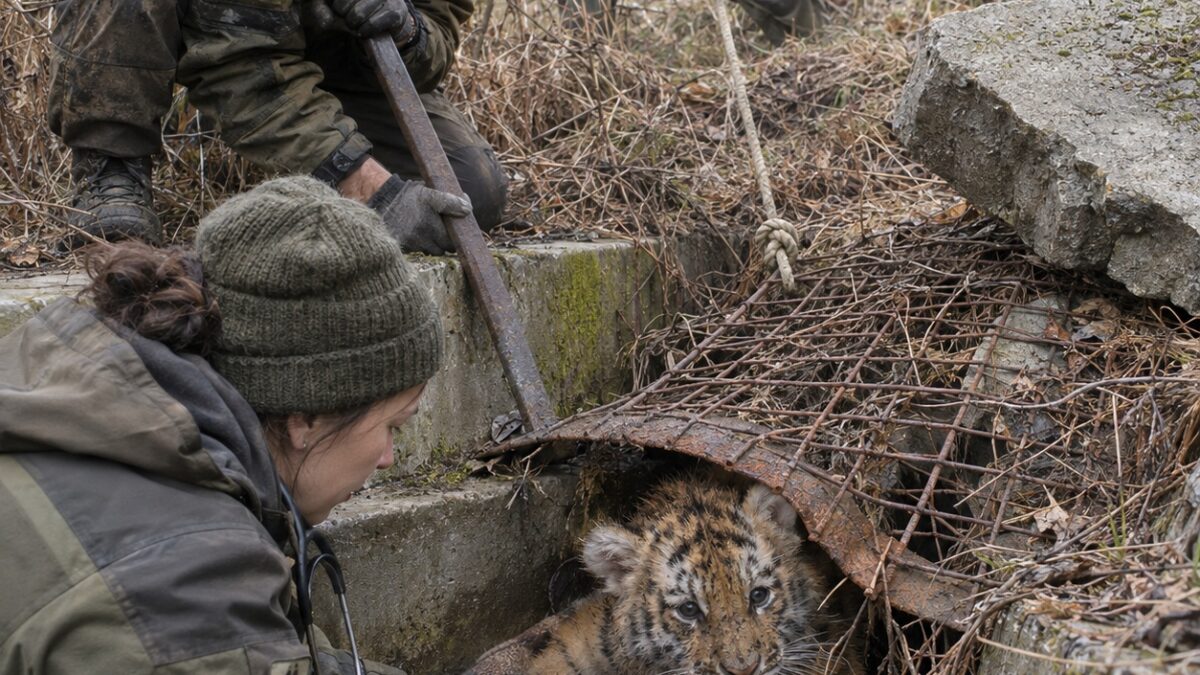
Pavel found an old drainage trench about forty yards from where we’d picked her up. Brambles and a mat of dead grass hid most of the opening. He called me from the upper bank and said he could see concrete and a section of wire mesh down inside.
“Hold on,” he said. “I’m going a little lower.”
I heard his jacket scrape against something. Then, faintly, a sound came through the phone, high and brief as air escaping a pinched balloon.
Pavel stopped moving. “Lena, there’s a cub down here.”
“Can you see it breathing?”
“Hang on.”
I pressed the phone hard against my ear. From the treatment room came the soft click of the pump delivering fluids to the tigress. I watched the numbers on its display change while I waited.
“Yeah,” Pavel said. “I can see its side move. Its nose is right up against the wire.”
“Stay where you are. Can you see what’s holding the wire up?”
He took a moment to answer. The mesh had folded inward, he said. One end was wedged against the concrete. The other disappeared under dirt and rock. He could get an arm down near the cub, but he couldn’t tell what would move with the wire if he pulled it.
I told him I was coming. My technician, Anya, took over at the clinic. I packed a warming blanket, a small carrier, and the bag I use for newborns. Then I went back for a second blanket. I’d heard one sound from that cub, and I’d already started thinking of him as a patient I’d be bringing back.
When I got there, the trains were running again. One was going through as I unloaded the truck. At the bottom of the embankment, I could feel it in the soles of my boots. The men at the trench paused until the last car went by and they could hear each other.
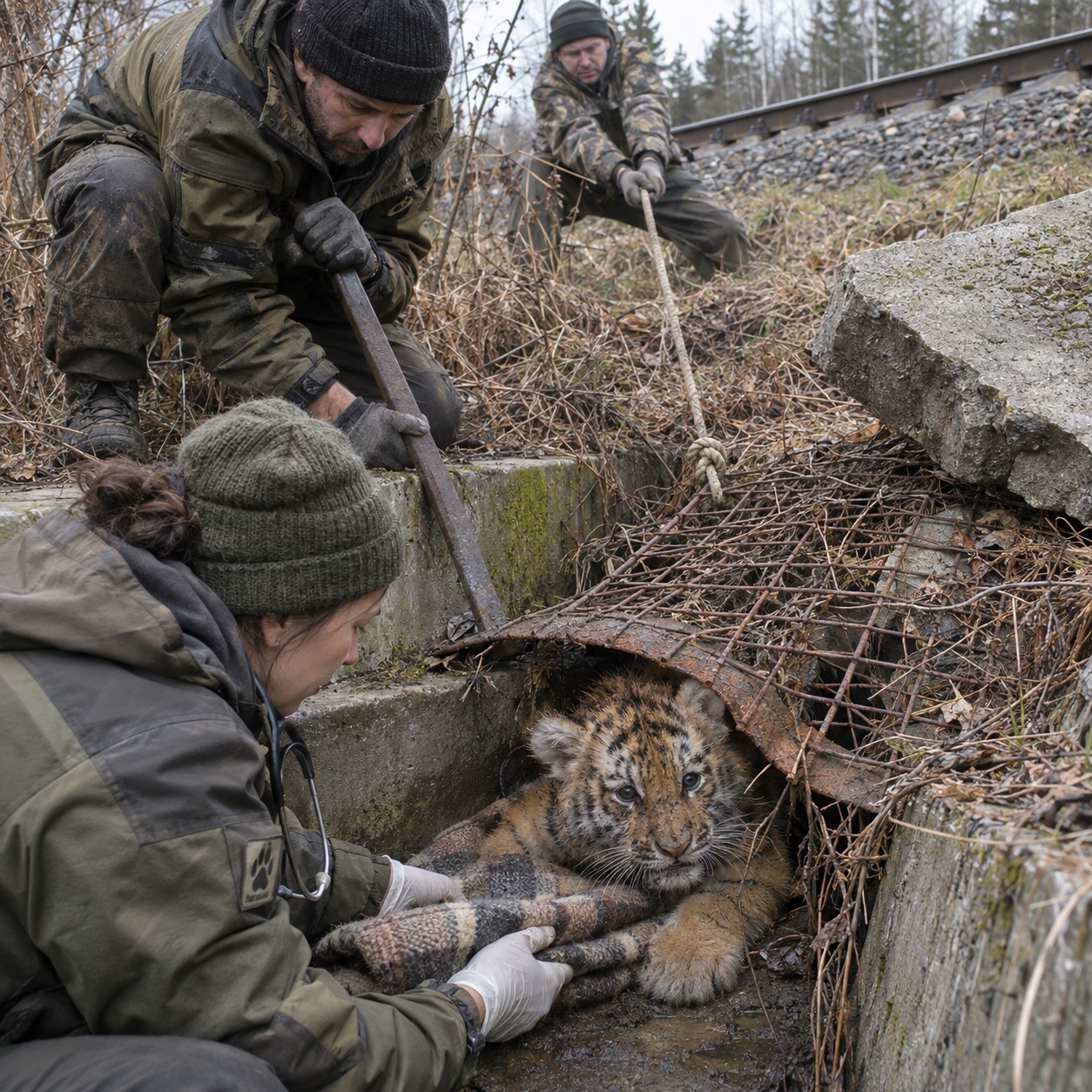
Pavel showed me where to put my feet. From a narrow shelf in the concrete I could just make out an ear and one striped shoulder. The cub’s body lay in the angle between the wall and the bowed mesh, with hardly enough room to turn his head. Pavel shone his light across the bottom. The dirt on the far side of the wire was scuffed bare. There were pale scratches on the old metal and tufts of orange fur on the ragged ends.
“Look there,” he said.
At first I thought I was looking at a wet leaf. Then I saw the torn edge of a piece of meat. There were several pieces along the base of the wall. One had dried almost black. Another still looked moist where it had split. They lay just inside the mesh, close enough for the cub to reach with his mouth.
Pavel moved the light up. Directly above the meat, a narrow place in the brush had been pressed flat. From there, an animal could lean over the trench. The wall dropped straight down beneath it.
I’d been thinking of the wire as something the tigress had escaped. Now I could picture her coming to the edge with food in her mouth, setting it down, and reaching as far as she could with her front feet. The bent ends of that mesh were right where her claws would have caught.
“How many times do you figure she came down here?” Pavel asked.
I kept looking at the pieces of meat, at the difference between the oldest one and the freshest. “More than once.”
The cub made the little sound again. His head shifted against the wire and came to rest at an angle. That was as much movement as I saw from him.
One of the crew, Misha, made his way down to the shelf. He studied the buried end of the panel and asked for a pry bar and a length of rope. They could take the weight from above while he worked the free corner out of the concrete. I would be able to reach in from beside him once there was room.
On his first try, the panel rose about an inch. A piece of broken concrete tipped with it. Dirt slid through the mesh onto the cub’s back.
“Set it down,” I said.
Misha lowered the bar. For a moment nobody spoke. I rubbed my thumb along a fold in the blanket and waited to see the cub’s ribs move under the dust. They did, twice.
Pavel had a clear view of the concrete from above. He got the crew to shift the rope toward the wall so it would pull the corner sideways and leave the broken slab seated. Misha scraped some dirt away from the free end with a gloved hand. This time, as the men took up the rope, I could see the slab stay where it was. The mesh came up slowly enough that I could follow the bent ends past the cub’s shoulder.
“Hold it there,” I said.
I slid the blanket under him as far as I could and worked one hand beneath his chest. He weighed so little that when I lifted him, I almost brought my empty hand up to meet him too fast. I tucked it under his hindquarters and kept him level. His body was cold through my gloves. The only resistance he gave me was a small tightening of his toes when the blanket touched them.
Misha turned his shoulder so I could get past. At the top, Pavel reached down for the bundle. I handed it up with the cub’s nose uncovered, and Pavel held him against his coat until I could climb out.
“He’s breathing,” he said before I could ask.
Back at the clinic, Anya had a quiet room ready. We warmed the cub gradually and treated his dehydration. I checked his limbs and listened to his chest. A little while later, as Anya changed the blanket under him, he drew his feet in close to his belly. I had a short list of things I wanted to see him do. I was glad to put a check beside that one.
His mother was in the next room. I wanted her to know he was there. I also had a cold, weak cub on a treatment table and a tigress who’d needed help getting her nose to a bowl of water. We settled him in a separate enclosure to rest. I was writing down his temperature when he called.
It was a thin sound, a little stronger than what I’d heard over the phone. Anya was standing at the observation window and motioned me over.
The tigress had raised her head. She was looking toward the wall the two rooms shared. The cub called again, and she got her front feet underneath her. Her legs shook. Her hindquarters came partway up and dropped back to the floor.
My hand went to the door latch out of habit. Then I took it away. She’d been resting almost flat on her side when I left for the railway. Now she adjusted one front foot, planted it, and tried again.
We moved the cub’s enclosure to the far side of a secure divider near hers. She could hear and smell him there, and each had space to rest. Anya and I watched from behind the glass while the cub turned twice in his bedding. The tigress lowered herself near the divider, eased her sore paws out in front of her, and stayed there.
That evening, I offered her a small portion of food. I’d been in and out of the room all day with something to check or record. This time I put the dish down and went out. When I came back, the dish had moved a few inches. The food was gone.
Over the next several days the tigress began making the short walk from the divider to her water. The cub started eating on his own. At first he’d spend most of the day asleep with his face tucked into the blanket. Then he got interested in the corner where it was folded over. He tugged it loose, tripped over it, and spent the rest of the afternoon dragging it around his enclosure.
When both were stronger, we let them share a larger holding pen and watched from the adjoining room. The cub approached her from behind and put one paw on her tail. The tip moved. He pounced on it with both feet. She turned, sniffed his back, and ran her tongue once between his ears. He stayed still for that, then went after her tail again.
I called Pavel and told him we could start talking about a release site.
“What about the ditch?” I asked.
“We got the panel out,” he said. “Come see the rest before you sign off.”
The railway crew and the reserve staff had worked their way along the old drainage channel, removing loose metal and sealing the openings an animal could fall through. On the day I went back, the grass was still flattened where we’d knelt with the cub. The panel lay on the service road, ready to be hauled away. I crouched next to it and saw several places where the old strands had frayed into little hooks. I’d kept the ones from the tigress’s feet in my desk. Here I could see the rest of what she’d been up against. The panel was nearly as long as I was tall. Even lying loose on the ground, it took two of us to turn it over.
We chose a release site deeper in the forest, well away from the line. By then the tigress could cross the holding pen with an even stride, and the cub was quick enough to get around her before she could finish washing his face. The morning we moved them, Pavel and I carried the cub’s crate together. At the truck he waited for me to say I had my end before he changed his grip.
We reached the site before dawn. The ground was soft enough that we could set the crates down without much noise. We opened both doors from cover and waited.
The cub came out first. He stopped with his back feet still on the lip of the crate and looked into the trees. For a few seconds I could see his breath. Then he stepped down and went a little way into the brush.
His mother followed. She paused outside her crate and lifted her nose. The cub had already slipped behind a stand of young trees, and from where I stood I could see only the branches moving. She went in after him. A branch sprang back, and the woods were still.
A few mornings later, the same freight engineer called the reserve about a dark shape farther up the line. The equipment crew found a fallen limb. I was at my desk when the notice came through, and I asked Pavel for the mile marker. We walked down the bank together and checked beneath the brush on both sides. At the bottom, clear water ran over a patch of fine sand. Along its edge was a set of small, five-toed prints. I held a branch aside while Pavel followed them uphill, where they came out in the grass beyond the tracks.