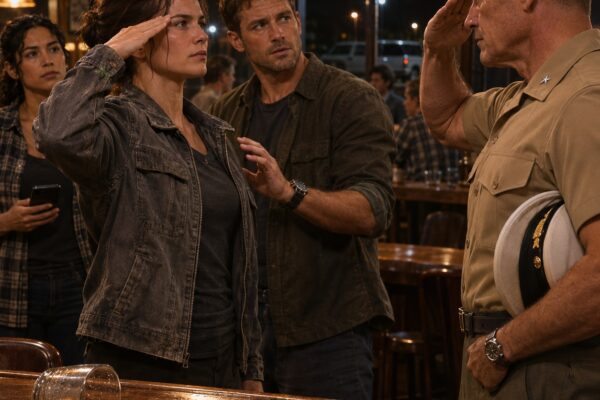
A Wealthy Businessman’s Son Slapped Me in a Diner After My Twelve-Hour Nursing Shift and Laughed When I Threatened to Call the Police. He Had No Idea My Husband Was a Marine General. But Instead of Sending Soldiers After Him, We Uncovered a Secret His Family Had Buried for Years. When I Finally Faced Him in Court, One Piece of Evidence Made His Father Turn White.
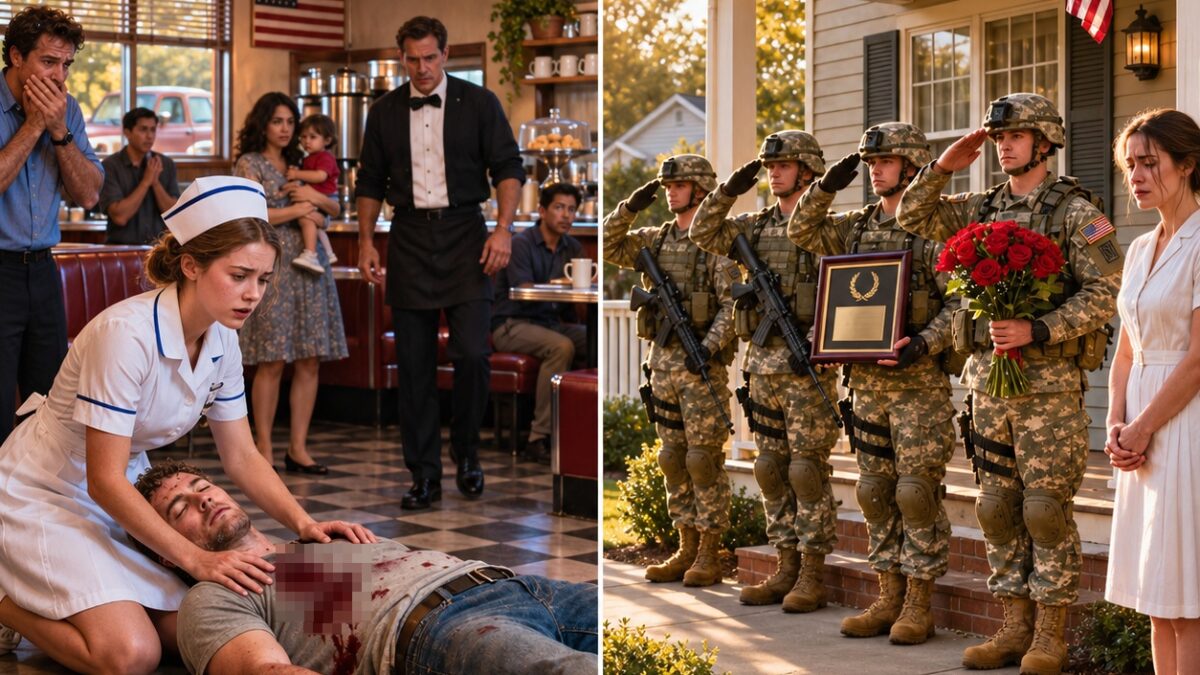
A Wealthy Businessman’s Son Slapped Me in a Diner After My Twelve-Hour Nursing Shift and Laughed When I Threatened to Call the Police. He Had No Idea My Husband Was a Marine General. But Instead of Sending Soldiers After Him, We Uncovered a Secret His Family Had Buried for Years. When I Finally Faced Him in Court, One Piece of Evidence Made His Father Turn White.
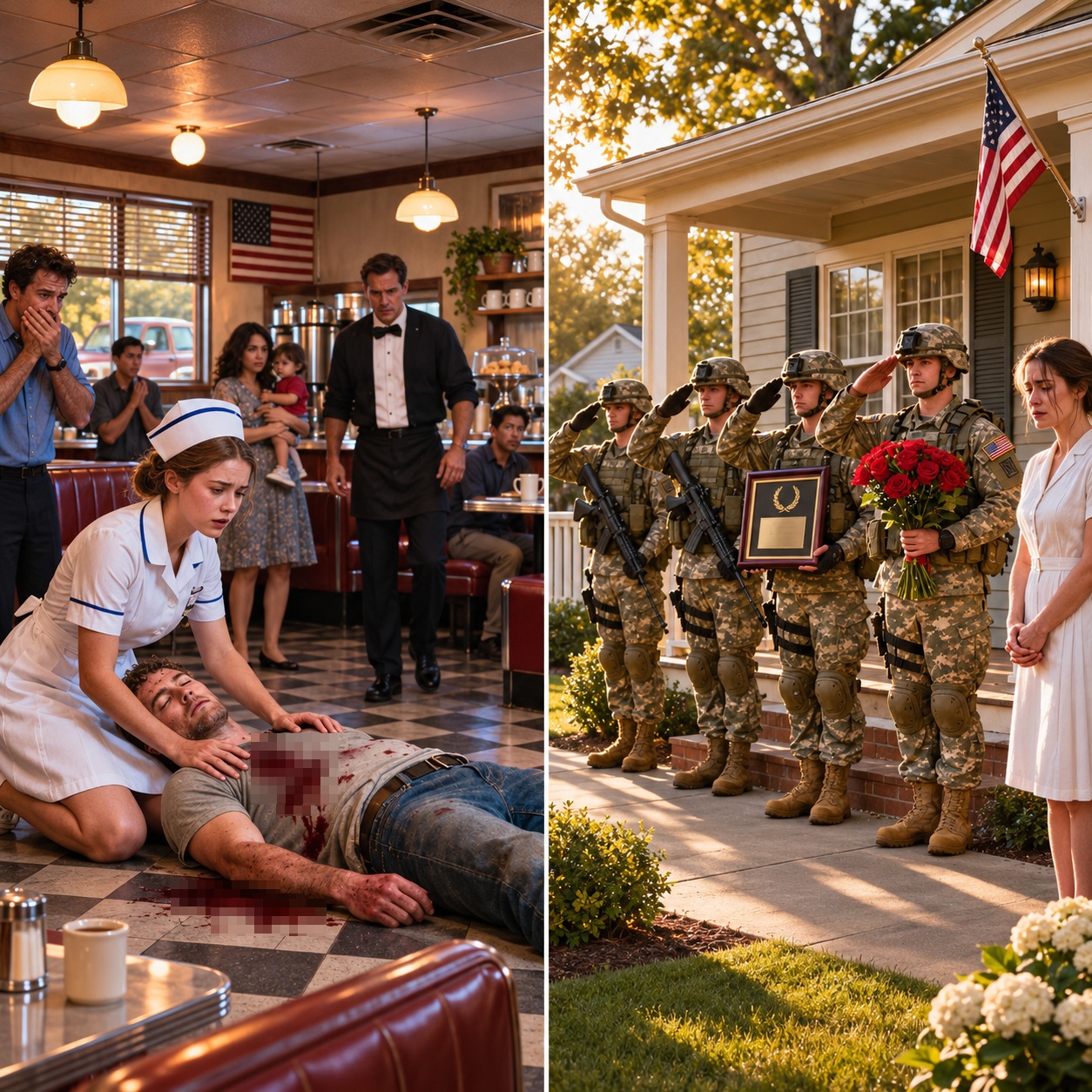
The slap was so hard that my coffee spilled across the table.
For three seconds, nobody in the diner moved.
Then the man who had hit me leaned closer and whispered, “Call whoever you want, sweetheart. My father owns half this town.”
He didn’t know my husband was a Marine general.
But what frightened me most wasn’t the man standing over me.
It was the waitress behind the counter, silently shaking her head, begging me with her eyes not to fight back.
My name is Rebecca Hayes. I was twenty-eight years old, working as an emergency room nurse at Harbor Point Medical Center in Norfolk, Virginia.
My husband, Daniel Hayes, was a brigadier general in the United States Marine Corps.
Most people didn’t know that.
Daniel and I had made a deliberate decision to keep his career separate from my work.
At the hospital, I was simply Rebecca, the nurse who volunteered for difficult shifts, brought homemade cookies for the night staff, and occasionally cried in the supply closet after losing a patient.
I didn’t want special treatment because of my husband’s rank.
And Daniel never wanted me to feel that his uniform mattered more than my own accomplishments.
We’d been married for four years.
He was fifteen years older than me, calm where I was emotional, patient where I sometimes rushed.
Our marriage wasn’t perfect.
His duties kept him away for weeks.
I worked nights.
Sometimes we communicated more through notes on the refrigerator than actual conversations.
But we loved each other.
And we had one rule.
Whatever happened outside our home, we faced it together.
That evening, I’d finished a twelve-hour shift that had felt like twenty.
A six-year-old boy had arrived with severe injuries after a car accident.
We managed to stabilize him, but I could still hear his mother’s terrified voice.
I wasn’t ready to go home and pretend everything was fine.
So I stopped at Miller’s Diner, a little family-owned restaurant near the hospital.
It had red booths, chipped coffee mugs, and the best chicken pot pie in Norfolk.
The owner, Mrs. Evelyn Miller, had been serving nurses and sailors for nearly thirty years.
“Rough night, honey?” she asked when I walked in.
I nodded.
“The usual?”
“Please.”
She brought coffee and squeezed my shoulder.
I sat by the window, grateful for the warmth.
Then the door opened.
And everything changed.
Brandon Whitmore walked inside.
He was thirty-two, handsome in an expensive, carefully maintained way, with a watch that probably cost more than my car.
His father, Charles Whitmore, owned construction companies, commercial properties, and several private healthcare facilities throughout the region.
Brandon had a reputation.
People whispered about his temper.
About employees who suddenly lost their jobs after disagreeing with him.
About women who stopped complaining after receiving threatening letters from attorneys.
I’d encountered him once before.
His father had recently acquired a financial interest in a medical staffing company that supplied temporary nurses to our hospital.
During a meeting about unsafe staffing levels, Brandon had dismissed my concerns.
“Maybe nurses should spend less time complaining and more time working,” he’d said.
I’d answered, “Maybe executives should try working a twelve-hour shift before deciding how many patients one nurse can safely handle.”
He hadn’t forgotten.
The moment he spotted me in the diner, his expression hardened.
“Well, look who it is.”
I kept my eyes on my coffee.
“Good evening, Brandon.”
He approached my booth.
“Still wearing those cheap scrubs?”
I didn’t answer.
He laughed.
“You know, my father pays people like you. You’d think you’d show a little respect.”
“I’m trying to eat dinner.”
He leaned over the table.
“You embarrassed me in front of my father’s business partners.”
“I raised a patient safety concern.”
“You made me look incompetent.”
I looked up.
“I didn’t do that, Brandon.”
His smile vanished.
Mrs. Miller appeared beside us.
“Sir, if you’re not ordering, please leave the young lady alone.”
Brandon turned toward her.
“Careful, Evelyn. Your lease comes up for renewal soon.”
Her face went pale.
I noticed.
And suddenly, I understood why she looked frightened.
“Don’t threaten her,” I said.
Brandon looked back at me.
“Excuse me?”
“You heard me.”
He laughed sharply.
“You really don’t know when to shut your mouth.”
I reached for my bag.
“I’m leaving.”
He grabbed my wrist.
“Sit down.”
“Let go.”
His fingers tightened.
I pulled away.
And he slapped me.
Hard.
My cheek burned.
My coffee cup tipped over.
Someone gasped.
Mrs. Miller dropped the plate she was carrying.
Brandon stood over me, breathing heavily.
Then he smiled.
“Maybe that’ll teach you some manners.”
I slowly stood.
My hands were trembling, but I kept my voice steady.
“You just assaulted me.”
He shrugged.
“Prove it.”
I looked toward the security camera above the counter.
His gaze followed mine.
Then he laughed again.
“My father’s company installed that system.”
He leaned close enough that I could smell the whiskey on his breath.
“Who do you think controls the recordings?”
For the first time, I felt genuinely afraid.
Not because he’d hit me.
Because he seemed absolutely certain nothing could happen to him.
I left the diner without another word.
Outside, rain soaked my scrubs.
I sat in my car and cried until I could breathe normally.
Then I took photographs of my swollen cheek and called the police.
An officer arrived, listened to my account, and took a report.
He told me the case would be reviewed.
But when I mentioned Brandon’s name, something changed in his expression.
I recognized it immediately.
Fear.
At home, Daniel was waiting in the kitchen.
He took one look at my face and went completely still.
“Rebecca.”
I tried to smile.
“It’s not as bad as it looks.”
He stepped closer.
“Who did this?”
I told him everything.
The diner.
The threats.
The slap.
The police report.
Daniel listened without interrupting.
Then he took my hand.
“Do you want me to call someone?”
I knew what he meant.
One phone call from a Marine general could attract attention.
But that wasn’t what I wanted.
“No,” I said. “I want him held accountable because he broke the law, not because of who I married.”
Daniel nodded.
“Then we do this properly.”
We documented my injuries, saved the police report number, and contacted an attorney.
Before going to bed, I called Mrs. Miller.
She answered on the third ring.
“Rebecca, please don’t come back here.”
“Evelyn, I’m not angry with you.”
“You don’t understand.”
Her voice was shaking.
“Brandon’s father has ruined people for less.”
“Did the security camera record what happened?”
Silence.
Then she whispered, “There’s something you need to see.”
My stomach tightened.
“What?”
“Come to the diner before we open. Use the back door.”
“Why?”
“Because the camera didn’t just record Brandon hitting you.”
I heard a noise on her end.
A door closing.
Then she spoke so softly I could barely hear her.
“Rebecca, I found a recording of his father ordering someone to destroy evidence from your hospital. And the patient whose name they mentioned died in your emergency room.”
PART 2
I gripped the phone.
“What patient?”
Mrs. Miller hesitated.
“I don’t want to say his name over the telephone.”
“Evelyn, how did your security system record a conversation about my hospital?”
“Charles Whitmore uses the back dining room for private meetings. He thinks I turn off the cameras when he comes in.”
My pulse quickened.
“Do you?”
“Not anymore.”
Before I could ask another question, she whispered, “Please come alone. And don’t tell anyone who works for the Whitmores.”
The call ended.
I stood in the kitchen, staring at my phone.
Daniel had heard enough to know something was wrong.
“What happened?”
I told him.
He listened carefully.
Then he said, “You’re not going alone.”
“Daniel—”
“I’m not sending Marines to a diner, Rebecca. I’m driving you there and waiting outside.”
I almost laughed.
Even frightened, he could still make me feel grounded.
We arrived before sunrise.
Mrs. Miller let us through the kitchen entrance.
Her hands shook as she locked the door.
“I shouldn’t have called you,” she whispered.
“Why?”
“Because if Charles finds out, I’ll lose everything.”
She led us into a small office behind the pantry.
An aging computer sat on a desk.
Beside it was an external hard drive.
Mrs. Miller opened a video file.
The footage showed the diner’s private dining room.
Charles Whitmore sat across from a man I recognized immediately.
Richard Collins.
He was the regional administrator for the staffing company that supplied temporary nurses to Harbor Point Medical Center.
My stomach dropped.
Mrs. Miller pressed play.
The audio was faint but understandable.
Charles spoke first.
“The hospital is asking too many questions about that night.”
Richard shifted in his chair.
“The internal review is nearly finished.”
“Then make sure the final report doesn’t mention the staffing changes.”
Richard looked uncomfortable.
“A patient died, Charles.”
“I know what happened.”
“His family hired an attorney.”
Charles leaned forward.
“Then give them a settlement offer. And make sure the original scheduling records disappear.”
I felt the room tilt.
Mrs. Miller stopped the recording.
“There’s more.”
But I already knew which patient they meant.
Michael Turner.
Forty-six years old.
A father of three.
He had arrived at our emergency department with severe chest pain.
That night, the department had been dangerously understaffed.
Two temporary nurses scheduled to work had never arrived.
Our charge nurse had spent hours calling the staffing agency.
Michael’s condition deteriorated while the team struggled to manage multiple emergencies.
We eventually transferred him to intensive care.
He died the following morning.
I remembered his wife.
I remembered her holding his wedding ring.
I remembered telling her I was sorry.
What I hadn’t known was that someone had allegedly altered staffing records afterward.
Daniel watched my face.
“Rebecca?”
I swallowed.
“I was there that night.”
Mrs. Miller pressed play again.
Richard’s voice filled the room.
“The original schedule shows we canceled two nurses to reduce costs.”
Charles answered, “Then the original schedule is a problem.”
A long silence followed.
Then Charles said something that made my blood run cold.
“If anyone asks, those nurses called out sick.”
Mrs. Miller stopped the video.
I covered my mouth.
Daniel’s jaw tightened.
But he didn’t speak.
I looked at Mrs. Miller.
“Why did you keep this?”
Her eyes filled with tears.
“Because my daughter used to work for Charles.”
“What happened?”
“She reported unsafe conditions at one of his facilities. A month later, she was fired. He made sure nobody else would hire her.”
She wiped her face.
“When I heard him talking about that patient, I couldn’t delete it.”
I looked toward the computer.
“Has anyone else seen this?”
“No.”
I took a breath.
“Then we need to preserve it properly.”
Daniel nodded.
“We contact your attorney. We don’t alter the original file, and we let investigators determine what it proves.”
For the first time that morning, Mrs. Miller looked relieved.
Our attorney, Laura Mitchell, met us later that day.
She listened to the recording.
Then she listened again.
“This is potentially serious,” she said. “But we need to be careful. A conversation isn’t the same as proving every allegation.”
I nodded.
“What happens now?”
“We preserve the recording, identify the original files, and provide the relevant information to the appropriate investigators.”
She looked directly at me.
“And Rebecca, you must not access confidential patient records to investigate this yourself.”
“I understand.”
“Good. Your nursing license matters. So does the integrity of this case.”
I thought about Michael Turner’s wife.
“Can we tell his family?”
Laura paused.
“Through the proper legal channels, yes. But we need to make sure we’re not spreading information we can’t substantiate.”
I agreed.
Then she asked about Brandon.
I showed her the photographs of my injuries and the police report.
Mrs. Miller had also preserved the diner footage showing the assault.
Unlike the private meeting recording, that video was unmistakable.
Brandon approached me.
Grabbed my wrist.
Slapped me.
And laughed.
Laura watched it without speaking.
When it ended, she looked up.
“He told you nobody could prove what happened?”
“Yes.”
“Well,” she said, “he was wrong.”
The next several weeks were the most frightening of my life.
Brandon was charged in connection with the assault.
His attorney contacted mine.
Then the threats began.
An anonymous letter appeared in our mailbox.
Drop the complaint. You don’t know who you’re dealing with.
A second arrived at the hospital.
Your career can disappear overnight.
Daniel wanted me to stay home.
I refused.
“I won’t let him decide whether I get to work.”
“I know,” Daniel said. “But being brave doesn’t mean ignoring danger.”
He was right.
We reported the threats.
Our attorney helped us document everything.
Daniel made sure I understood that his military position couldn’t be used to influence civilian investigators or the court.
He supported me as my husband.
Not as a general issuing orders.
And somehow, that made me love him more.
The larger investigation moved slowly.
Investigators obtained records through lawful requests.
Former employees came forward.
One staffing coordinator produced emails showing that shifts had been canceled for financial reasons while hospital managers had been told the nurses were unavailable.
Another employee described pressure to change internal reports.
The evidence suggested a pattern that extended beyond Michael Turner’s case.
I learned that other nurses had complained about understaffing.
Some had been ignored.
Others had lost assignments.
The hardest conversation came when Michael’s widow, Sarah Turner, agreed to meet with me.
We sat in a quiet room at our attorney’s office.
She looked exhausted.
There were shadows beneath her eyes.
For a moment, neither of us spoke.
Then she said, “You were one of the nurses who cared for my husband.”
I nodded.
“Yes.”
“Did you know he was going to die?”
My throat tightened.
“No.”
“Did you know the hospital was short-staffed?”
“Yes.”
Her eyes filled.
“Then why didn’t anyone tell me?”
I looked down at my hands.
“We raised concerns that night. But I didn’t know the full extent of what was happening behind the scenes.”
She was silent.
I forced myself to continue.
“Sarah, I can’t tell you that more nurses would definitely have saved Michael. I wish I could. But you deserved an honest account of what happened.”
Tears rolled down her cheeks.
“For months, I thought I was crazy for asking questions.”
“You weren’t.”
She looked at me for a long moment.
Then she asked, “Why are you helping me?”
I thought about the diner.
The slap.
The humiliation.
The moment I’d realized Brandon believed money made him untouchable.
“Because I know what it feels like when someone powerful expects you to stay quiet.”
Sarah reached across the table.
And took my hand.
The criminal case against Brandon moved forward separately.
The video was admitted as evidence.
Mrs. Miller testified.
So did two customers who had witnessed the assault.
Brandon’s attorney suggested the confrontation had been exaggerated.
Then the prosecutor played the footage.
I watched Brandon’s face as the screen showed his hand striking mine.
His expression changed.
For the first time since the diner, he didn’t look amused.
He looked frightened.
When I testified, my voice shook.
I didn’t try to hide it.
I described what happened.
I explained that I’d asked him to leave me alone.
That he’d grabbed my wrist.
That he’d hit me.
And that I’d been afraid to report him because of his family’s influence.
During cross-examination, his attorney asked, “Isn’t it true your husband is a high-ranking Marine officer?”
“Yes.”
“Did you believe that connection would help you?”
“No.”
“Then why did you mention it to investigators?”
“I didn’t. They learned about my marriage during the normal course of the case.”
The attorney paused.
I looked toward the judge.
“I reported Brandon because he assaulted me. My husband’s rank doesn’t change what happened.”
The courtroom went quiet.
Daniel sat behind me in a dark civilian suit.
He gave me a small nod.
I continued.
“I don’t want special treatment. I want the same protection anyone else should receive.”
Brandon was convicted of misdemeanor assault.
The judge imposed a sentence that included probation, community service, and a requirement to complete an intervention program.
It wasn’t a dramatic movie ending.
Nobody dragged him screaming from the courtroom.
There was no sudden confession.
But he had been held accountable.
And for me, that mattered.
The investigation involving his father’s business took longer.
Much longer.
Financial records had to be examined.
Witnesses were interviewed.
Attorneys argued over documents.
Some allegations couldn’t be proved.
Others could.
Eventually, prosecutors brought charges against Charles Whitmore and Richard Collins related to falsified business records and obstruction.
Charles denied wrongdoing.
He fought the charges.
But the evidence continued to accumulate.
The turning point came when a former accounting manager testified that Charles had personally approved payments intended to conceal staffing irregularities.
The manager produced original emails and financial records.
They matched details from the diner recording.
Charles’s attorneys challenged the evidence.
The court examined it.
And the case that had once seemed impossible to prove began to take shape.
When the verdict came, I sat beside Sarah Turner.
Daniel held my other hand.
Charles was found guilty on multiple counts connected to the falsification and concealment of records.
Richard Collins was also convicted for his role.
The courtroom remained almost silent.
Sarah squeezed my fingers.
I looked toward Charles.
He was staring straight ahead.
The man who had once threatened to ruin anyone who questioned him could no longer control the story.
Outside the courthouse, reporters surrounded us.
“Rebecca! How does it feel to bring down the Whitmore family?”
I stopped.
I looked at the cameras.
“I didn’t bring down anyone.”
The reporters quieted.
“I reported an assault. Other people came forward with evidence of wrongdoing. Investigators and the courts did their jobs.”
I took a breath.
“And a family that had been asking questions about a loved one’s death finally got some answers.”
A reporter asked whether I felt vindicated.
I thought about Sarah.
About Michael’s children.
About Mrs. Miller, who had nearly lost her diner.
Then I answered.
“I’m relieved. But no verdict brings back the people we’ve lost.”
The civil cases continued after the criminal proceedings.
Several affected families pursued claims.
Some reached settlements.
The hospital and its staffing contractors faced closer scrutiny.
New staffing oversight procedures were introduced.
Not everything changed overnight.
There were still arguments about budgets.
Still exhausting shifts.
Still administrators who didn’t understand what happened in an emergency department at three in the morning.
But nurses who had once been afraid to speak began raising concerns openly.
And this time, people listened.
Mrs. Miller kept her diner.
A local business group helped her negotiate a more secure lease.
The first time I returned, she brought me chicken pot pie and refused to let me pay.
“Evelyn,” I protested, “you can’t keep feeding me for free.”
She smiled.
“Watch me.”
Then her expression softened.
“I almost stayed quiet, Rebecca.”
I reached for her hand.
“But you didn’t.”
She glanced toward the security camera.
“I kept thinking about what my daughter went through.”
“And you helped other families avoid the same thing.”
Mrs. Miller nodded.
For the first time since that terrible evening, the diner felt like a safe place again.
Daniel and I began spending more time together.
Not because his schedule suddenly became easier.
But because we stopped assuming there would always be another evening.
We ate dinner at the kitchen table.
We went for walks.
Sometimes we talked about the case.
Sometimes we talked about absolutely nothing.
One night, he asked, “Do you regret standing up to Brandon?”
I thought about it.
“I regret that he hit me.”
Daniel nodded.
“I know.”
“I regret the fear. The threats. The nights I couldn’t sleep.”
He took my hand.
“But?”
I smiled sadly.
“But I don’t regret telling the truth.”
He leaned over and kissed my forehead.
“Neither do I.”
After the case, Sarah Turner helped establish a small scholarship fund for nursing students interested in patient advocacy.
I joined its volunteer committee.
Mrs. Miller donated food for our first fundraiser.
Several former hospital employees helped organize it.
Daniel attended in civilian clothes and spent most of the evening carrying chairs.
Someone recognized him.
“General Hayes, shouldn’t you be giving the speech?”
He laughed.
“My wife is the one you came to hear.”
I watched him from across the room.
And I realized something.
The greatest gift Daniel had given me wasn’t the protection of his rank.
It was the freedom to stand on my own.
He had never tried to take over my fight.
He had simply refused to let me face it alone.
Months later, I was working another evening shift when an elderly patient grabbed my hand.
She had been frightened during a procedure.
I stayed beside her until she relaxed.
“Thank you, sweetheart,” she whispered.
I smiled.
“Of course.”
She studied my face.
“Aren’t you that nurse from the news?”
I hesitated.
“Yes, ma’am.”
“The one who stood up to that wealthy family?”
I nodded.
She squeezed my hand.
“My granddaughter wants to become a nurse. She says you’re brave.”
I felt my throat tighten.
“Tell her nursing takes courage. But it also takes kindness, patience, and a willingness to ask for help.”
The woman smiled.
“I’ll tell her.”
When my shift ended, I stepped outside into the cool Virginia air.
Daniel was waiting beside his truck.
He held two paper cups of coffee.
“Your usual,” he said.
I took one.
“You’re spoiling me.”
“That’s the plan.”
We walked toward the parking lot.
For a moment, I thought about the night Brandon slapped me.
How small I’d felt.
How certain he’d been that I would stay silent.
How frightened Mrs. Miller had looked.
Then I thought about everything that followed.
The witnesses who came forward.
The families who finally received answers.
The nurses who found their voices.
The people who had refused to look away.
Daniel opened the passenger door for me.
Before getting in, I turned toward him.
“Do you know what Brandon said after he hit me?”
Daniel’s expression darkened.
“What?”
“He said his father owned half the town.”
Daniel waited.
I looked back at the hospital, its windows glowing against the night sky.
“And for a while, I believed that meant he could do anything.”
I took Daniel’s hand.
“But I was wrong.”
He smiled gently.
“About what?”
I looked at him.
“His father could buy buildings, businesses, and expensive lawyers. But he couldn’t buy the truth once enough people were brave enough to tell it.”
Daniel squeezed my hand.
We drove home together.
And the next morning, I put on my scrubs and returned to work.
Not as a general’s wife.
Not as the woman from the headlines.
But as Rebecca Hayes.
A nurse.
A wife.
A woman who had been frightened, hurt, and humiliated—and had refused to let that become the end of her story.
Brandon thought one slap would teach me to stay silent.
Instead, it became the first piece of evidence in a fight his family never imagined they could lose.
And the greatest victory wasn’t watching a powerful man face a judge.
It was knowing that the next frightened woman, exhausted nurse, or grieving family might finally believe that their voice was worth hearing.